LawSites
As they adapt to rapid technological change, law libraries and legal information professionals are experiencing their highest staffing levels in nearly a decade, according to a comprehensive new industry survey released yesterday.
But salaries for those in law libraries vary widely, depending on the type of library and career stage. While the highest base salary is $281,860 for the director of research and library services at a northeastern U.S. law firm, the lowest is $32,697 for someone in the category of “clerk/fellow/intern/student assistant” at a government law library.
The 2025 American Association of Law Libraries (AALL) Biennial Salary Survey & Organizational Characteristics report found that law libraries now average 6.6 full-time equivalent positions, up from 4.6 in 2019 and marking the strongest staffing growth the profession has seen in years.
The report, which surveyed 257 organizations across academic, firm/corporate and government law libraries, provides what AALL describes as the most detailed compensation benchmarks available for legal information professionals. The survey achieved a 45% response rate.
“At a time of rapid change — when legal institutions face new challenges and technology continues to reshape how we work — the AALL Salary Survey is more essential than ever,” said AALL President Jenny Silbiger, state law librarian for the Hawaii State Judiciary.
“It’s a valuable resource to analyze how salaries align with new developments in the legal information profession, providing reliable, up-to-date data that supports planning, hiring and informed conversations across the profession.”
AALL says that the 2025 survey introduces extensive updates to job titles and descriptions — the most sweeping since at least 2015. The AALL’s Economic Status of Law Librarians Committee revised hundreds of titles and consolidated overlapping roles to better reflect modern responsibilities, particularly in technical services, digital resources, and firm/corporate research organizations.
Private-sector classifications were reorganized around seniority and managerial progression, providing clearer benchmarking for roles such as senior manager, manager and non-supervisory research professionals — categories that increasingly mirror law firms’ own competency frameworks.
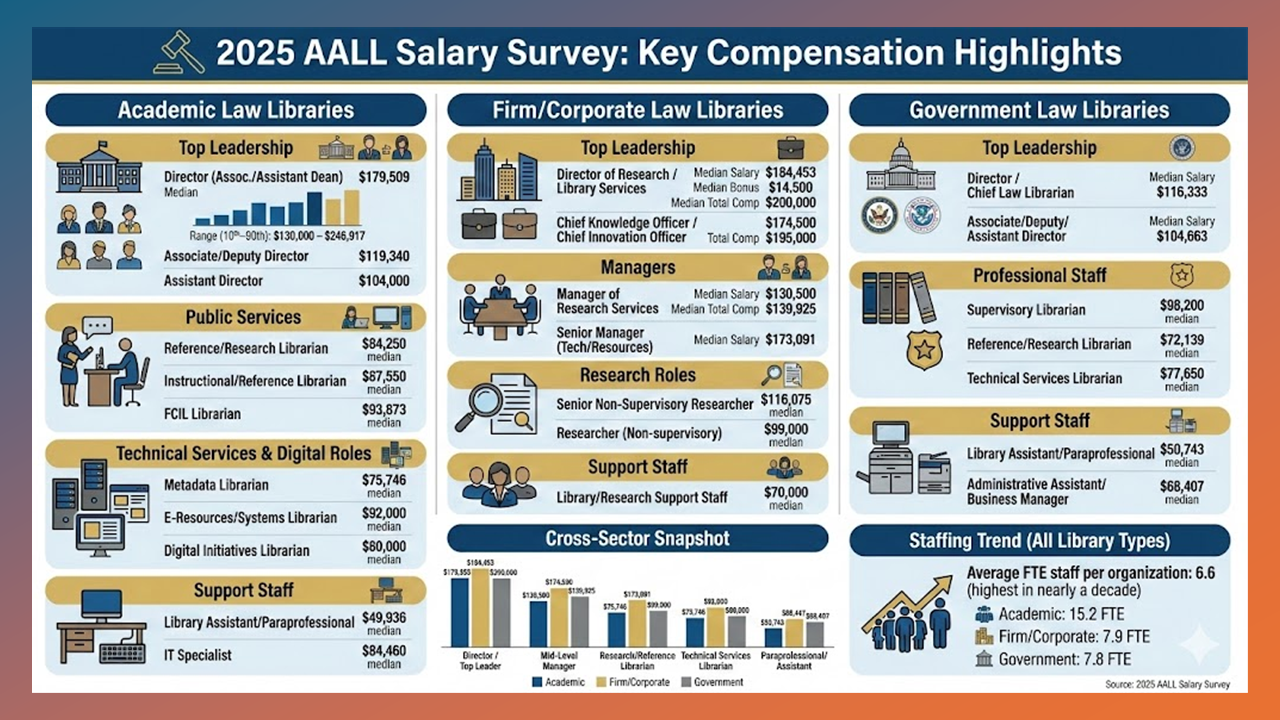
Infographic: Copyright 2025 LawNext Media; Date source: 2025 AALL Salary Survey
Staffing Levels Show Growth
Across all library types, staffing has grown steadily, with organizations reporting an average of 6.6 full-time equivalent (FTE) employees. This is up from 6.1 in 2023 and sharply higher than 4.6 in 2019.
Academic law libraries remain the largest employers, averaging 15.2 FTEs per institution. Firm and corporate law libraries now average 7.9 FTEs, and government law libraries average 7.8 FTEs.
Compensation Varies Widely
The survey reveals significant salary variations across different types of law libraries and career stages.
Academic Law Libraries
Academic law libraries showed directors earning a median salary of $179,509, with substantial variation based on law school size and geographic region. Directors’ salaries ranged from the 10th-percentile figure of $130,000 to a 90th-percentile high of $246,917. Private-school directors continue to out-earn their public-school counterparts, a pattern consistent with prior survey cycles.
Other notable academic medians include:
- Associate/deputy directors: $119,340.
- Assistant directors: $104,000.
- Reference/research librarians: $84,250.
- Instructional/reference/research librarians: $87,550.
- Metadata librarians: $75,746.
- Library assistants/paraprofessionals: $49,936.
These roles vary widely by region, size of institution, and experience level, but overall compensation remains on an upward trajectory.
Read full article at