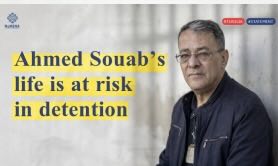
HuMENA expresses deep concern regarding the serious health developments affecting lawyer and former administrative judge Ahmed Souab inside Mornaguia Prison on 5 January 2026. On that day, Souab suffered acute nosebleeding in the morning, followed by more severe bleeding in the afternoon that led to loss of consciousness. On 6 January 2026, Saeb Souab (Ahmed Souab’s son) published the details of the incident and noted his father’s chronic heart conditions, as well as the need for specialised medical diagnosis to determine the causes of recurrent bleeding and to establish a clear treatment and medical follow-up plan. The association Taqattoua for Rights and Freedoms also confirmed the incident in a case-related statement.
HuMENA affirms that these facts impose immediate and specific obligations on the Tunisian authorities: ensuring the detainee’s access to diagnostic examinations appropriate to his condition, specialist assessment where necessary, and referral to a civilian medical facility when adequate conditions for diagnosis or treatment are not available in prison, with medical interventions documented in a manner that enables review. This is not a “humanitarian measure”, but a legal duty linked to the protection of the right to life and physical integrity, and to the prohibition of cruel, inhuman or degrading treatment where it results from medical neglect, unjustified delay, or denial of referral to specialised care.
Legally, Tunisia is bound to guarantee these rights under binding international and regional instruments, foremost the International Covenant on Civil and Political Rights, in particular the prohibition of torture or cruel, inhuman or degrading treatment (Article 7), the right to liberty and security of person and protection against arbitrary detention (Article 9), and fair trial guarantees and defence rights (Article 14). Tunisia is also obliged to prevent cruel, inhuman or degrading treatment under the Convention against Torture (Article 16), and under the African Charter on Human and Peoples’ Rights, particularly as regards dignity and integrity (Article 5), liberty and security (Article 6), and fair trial (Article 7). The Nelson Mandela Rules further frame the State’s duties regarding equivalence of healthcare in detention to that available in the community, the independence of medical decision-making, and the obligation to refer detainees to appropriate healthcare facilities when needed.
HuMENA does not view the health dimension in isolation from the context that led to Ahmed Souab’s detention. He was arrested on 21 April 2025 and referred to the Judicial Counter-Terrorism Pole following public statements in which he criticised the state of the judiciary and the pressures imposed on it, in a context linked to his work as a lawyer in the “conspiracy case”. On 31 October 2025, a first-instance judgment sentenced him to five years’ imprisonment, with three years of administrative supervision. This sequence raises a specific human rights issue: the limits of criminalising expression when it is made by a lawyer in a professional context related to judicial affairs, and how such criminalisation can, in practice, restrict the right to defence in politically sensitive cases.
HuMENA stresses that protecting the freedom of defence is not merely a professional demand, but a core guarantee of the right to a fair trial.