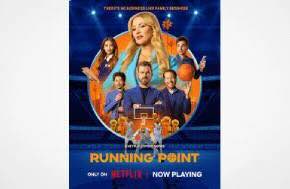
Trademark claims against Netflix concerning its popular “Running Point” comedy series were recently dismissed at the pleadings stage due to a one-letter misarticulation of applicable First Amendment law. The case, soon to be litigated on appeal, highlights the need to clarify the contours of trademark liability arising from creative works.
Pepperdine University filed the lawsuit last year against Netflix and co-defendants Warner Bros. and Kaling International, just one week before the “Running Point” series premiere. Loosely based on the life of Los Angeles Lakers owner Jeanie Buss, the series stars Kate Hudson as the owner of the fictional basketball team the Los Angeles Waves. The popular series, which amassed instant popularity and ranked as Netflix’s #1 TV show, was quickly ordered for a second season that premiered April 23, 2026.
Pepperdine alleged that the “Los Angeles Waves” infringed the university’s WAVES trademarks for college athletics; the show’s creators countered that the use was protected artistic expression. Agreeing with the creators, the U.S. District Court for the Central District of California dismissed Pepperdine’s complaint based on Rogers, a well-established First Amendment defense to infringement. Under this defense, an accused infringement occurring within a creative work is generally non-actionable unless it “explicitly misleads as to the source or the content of the work.”
The court, however, misarticulated the Rogers test by one letter—using “of” in place of “or.” The one-letter difference is significant because it, unlike the established rule, makes virtually all instances of false endorsement within creative works immune from trademark liability.
Pepperdine has stated its intent to appeal the decision, with its Notice of Appeal at the U.S. Court of Appeals for the Ninth Circuit due May 15, 2026. Resolving this case, however, may require more than simply correcting a clerical error. If the appeal goes forward, its outcome will ultimately weigh on whether trademark owners can continue to expect compensation for unauthorized uses of their trademarks within media for entertainment value rather than as an indicator of source.
Rogers Defense: Explicit Deception as to Source or Content
Originating from the Second Circuit case Rogers v. Grimaldi in 1989, Rogers is an affirmative defense to trademark infringement that has been adopted by courts nationwide as a First Amendment defense for creators and artists. Rogers applies when the accused use occurs within a creative work such as a film or TV show. Once a defendant invokes Rogers, there is ordinarily no trademark liability unless the plaintiff shows that the accused trademark “explicitly misleads as to the source or the content of the work.”
This “source or content” standard is well-established, as affirmed by the Supreme Court when it famously addressed the Rogers test in 2024 in Jack Daniel’s Properties v. VIP Products. Content-related deception is necessarily broader than literal source confusion regarding who produced the artistic work at issue; otherwise, the Rogers test would not identify “source” and “content” as two different items. Supporting this principle, Lanham Act section 43(a) recognizes trademark infringement through false endorsement if consumers are led to falsely infer “affiliation, connection, association…sponsorship, or approval” of the accused artistic work. These false endorsement theories pertain to the content of the work, without requiring consumers to believe that the plaintiff was the actual source of the artistic work.
Understandably, Rogers is not defeated any time there is ordinary false endorsement sufficient to state a claim under the Lanham Act. To preserve free-speech latitude for artistic works, the Rogers defense is defeated only when it is shown that the alleged false endorsement of content is explicit.
The Court’s Error: Explicit Deception as to Source of Content
Whether Pepperdine’s alleged implied endorsement of the series is sufficiently “explicit” under Rogers is a question of degree that ordinarily should not be resolved on a motion to dismiss. The court, however, seemingly ignored the fact that false endorsement—i.e., explicit content deception not involving source—is even an avenue to defeat Rogers dismissal.
Read More
Trademark Claims Against Netflix Dismissed Due to One-Letter Typo in Court Order