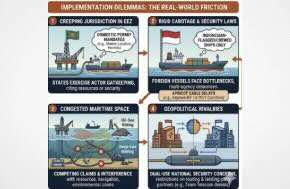
This article examines the provisions of UNCLOS relating to subsea cable projects, with a particular focus on the legal regime within the Exclusive Economic Zone (EEZ) and on the continental shelf, and analyzes the implementation dilemmas arising from conflicts between UNCLOS provisions and coastal States’ domestic laws and regulations.
1 Introduction
Submarine cables are the invisible backbone of the global digital economy, carrying over 99 per cent of intercontinental data traffic, including trillions of dollars in daily financial transactions and the communications that underpin modern cloud computing and AI workloads. The legal framework governing the laying, maintenance and protection of these cables across maritime zones is primarily defined by the United Nations Convention on the Law of the Sea (UNCLOS). Adopted in 1982, the UNCLOS was negotiated at a time when internet usage was not yet widespread, and the treaty‘s drafters did not anticipate the strategic criticality of subsea cables in the 21st century. This has created growing tensions between the freedom of all States to lay cables and the sovereign rights of coastal States to manage their offshore resources and protect their national security interests.
This article examines the provisions of UNCLOS relating to cable laying, with a particular focus on the legal regime within the Exclusive Economic Zone (EEZ) and on the continental shelf. It analyses the distinction between submarine cables (telecommunications) and pipelines (energy) – a critical doctrinal difference often overlooked. The article introduces the anomaly in the international law of the sea presented by the United States, a country with the largest number of submarine cables and the most sophisticated cable?landing regulatory regime, but not a party to UNCLOS. The article then turns to the practice of Indonesia, a strategic archipelagic State whose 2021 regulatory framework on submarine cable corridors has imposed significant constraints on international cable projects such as Apricot and Echo, causing multimillion-dollar delays and forcing a fundamental rethink of cable routing through Southeast Asia.
2 The UNCLOS Framework for Submarine Cables
The UNCLOS adopts a zonal approach, under which the rights and obligations of both coastal States and other States vary according to the maritime zone in which a cable is laid. The most relevant zones for international cable projects are the territorial sea, the Exclusive Economic Zone (EEZ), and the continental shelf.

2.1 The Territorial Sea: Full Sovereignty
Within the territorial sea, which extends up to 12 nautical miles from the baselines, the coastal State exercises full sovereignty over the water column, the seabed and the subsoil. Under Article 2 of UNCLOS, this sovereignty is exercised subject to the Convention and other rules of international law, but the coastal State retains the exclusive right to regulate all activities within this zone. Consequently, any submarine cable that lands on the shore – or even transits through a coastal State‘s territorial waters – is subject to the domestic permitting and licensing requirements of that State. In practice, this means that cable landing licences must be obtained from the coastal State’s telecommunications regulator, and environmental permits, seabed clearance and other approvals are also required.
2.2 The Exclusive Economic Zone: A Delicate Balance
The EEZ, extending up to 200 nautical miles from the baselines, is a `sui generis‘ zone in which the coastal State possesses sovereign rights for the purpose of exploring and exploiting natural resources and certain economic activities (Article 56). However, other States retain the freedoms of the high seas (Article 58), including the freedom to lay submarine cables and pipelines (Article 87(1)(c)). Under Article 58, all States enjoy the right to lay and maintain submarine cables in another State’s EEZ, subject to the obligation to have `due regard‘ to the rights and duties of the coastal State.
This creates a delicate balance. The coastal State cannot prohibit or impede the laying of a transit cable simply because it traverses its EEZ. Article 79(2) reinforces this principle for the continental shelf, stating that the coastal State `may not impede the laying or maintenance of such cables or pipelines‘, except when exercising its rights to explore the shelf, exploit its natural resources, or prevent pollution from pipelines.
Critically, however, UNCLOS draws a sharp distinction between cables and pipelines. Under Article 79(3), the delineation of the route for pipelines on the continental shelf is subject to the consent of the coastal State. For cables, no such consent is required for the route itself when the cable merely transits the EEZ without landing. This doctrinal distinction is central to understanding the legal tensions that have emerged in Indonesia and other archipelagic States.
2.3 The High Seas and the Continental Shelf
On the high seas (beyond 200 nautical miles), the freedom to lay cables is absolute, subject only to the general obligation to have due regard for other lawful uses of the sea. On the continental shelf, even where it extends beyond 200 nautical miles, Article 79(1) confirms that all States are entitled to lay cables and pipelines. The coastal State‘s powers are limited to taking reasonable measures to explore and exploit natural resources, and to prevent pollution – measures that must not unreasonably impede the laying or maintenance of cables.
3 The United States: A Non?Party That Shapes the Rules
The United States presents a striking anomaly in the international law of the sea. As the country with the largest number of submarine cables and the most sophisticated cable?landing regulatory regime, it is not a party to UNCLOS. The United States signed the Convention in 1994 but has never ratified it, owing to longstanding political opposition in the Senate. Despite this, successive U.S. administrations have recognized that the vast majority of UNCLOS provisions, including those on navigation and overflight, reflect customary international law and are binding on all States regardless of treaty membership.
3.1 U.S. Compliance with UNCLOS Norms
In practice, the United States follows the substantive rules of UNCLOS. It respects the 12?nautical?mile territorial sea, the 200?nautical?mile EEZ, and the freedom to lay submarine cables in foreign EEZs. U.S. cable operators routinely obtain permits from coastal States when landing cables on their shores, and the U.S. government has consistently invoked UNCLOS principles to uphold freedom of navigation and communication, including the right to lay and maintain cables on the high seas and continental shelves.
3.2 Domestic Regulations that Exceed UNCLOS
Where the United States diverges most sharply from the UNCLOS framework is in its domestic regulatory overlay. The Federal Communications Commission (FCC) exercises extensive authority over the landing of submarine cables on U.S. shores, including rigorous national security reviews. Since 2020, the FCC has designated China, Russia, Iran, North Korea, Cuba and the Maduro regime as “foreign adversaries”. It has adopted rules that presumptively deny cable landing licences to applicants controlled by or subject to the jurisdiction of a foreign adversary, and it has barred U.S. carriers from interconnecting with such entities. The FCC‘s 2026 Notice of Proposed Rulemaking goes further, proposing to ban Chinese carriers from operating data centres and Points of Presence in the United States and to prohibit any carrier using Huawei or ZTE equipment from interconnecting with U.S. networks.
These measures have no analogue in UNCLOS. The Convention does not give coastal States the right to exclude cable operators based on their country of origin or to impose such sweeping supply?chain restrictions. Yet because the United States is not a party to UNCLOS, it is not formally bound by its dispute?resolution mechanisms. The U.S. approach exemplifies how a powerful non?party can shape the global subsea cable landscape through domestic legislation, effectively exporting its standards to allied nations without being constrained by the treaty‘s limitations.
3.3 The U.S. as a Complementary Case
Unlike Indonesia, which asserts jurisdiction over its EEZ in ways that scholars have questioned as “creeping jurisdiction”, the United States does not claim the right to veto transit cables in other States‘ waters. Its regulatory reach is focused on its own territory and its own landing stations. The effect, however, is similar: both countries impose conditions on cable projects that go beyond the letter of UNCLOS, albeit through different legal mechanisms. For Indonesia, the vehicle is marine spatial planning and cabotage laws; for the United States, it is national security licensing and supply?chain vetting. Both demonstrate that the abstract freedoms of UNCLOS are often tempered by the practical realities of domestic law and geopolitical interests.
4 The UNCLOS‘s Enforcement Gaps and Creeping Jurisdiction
While UNCLOS provides a clear framework of rights and obligations, its enforcement mechanisms are notoriously weak. Article 113 requires States to criminalise the wilful or negligent breaking of cables on the high seas, but jurisdiction is limited to flag States – a regime that proves ineffective when damage is caused by vessels flying flags of convenience. Moreover, the Convention says almost nothing about the protection of cables in the EEZ, leaving coastal States to rely on their domestic laws to fill the void.
This has given rise to what maritime lawyers term ‘creeping jurisdiction‘ – the tendency of coastal States to assert ever?broader regulatory control over activities in their EEZ, ostensibly on environmental or spatial planning grounds, but in practice expanding their authority beyond what UNCLOS originally contemplated. Scholars have documented how countries such as Indonesia, China, India and several European nations have adopted domestic laws requiring foreign cable-laying vessels to secure environmental permits, undergo national security screening, or pay administrative fees before operating within their 200-mile EEZ.

Image generated with AI, Copy Right Reserved @ SubmarineNetworks.com
5 Indonesia: A Case Study in Creeping Jurisdiction
Indonesia occupies a uniquely strategic position in the global subsea cable network. As an archipelagic State straddling the major sea lanes between the Indian and Pacific Oceans, its waters are traversed by a dense web of international submarine cables connecting Southeast Asia to Australia, the United States and beyond. In recent years, Indonesia has emerged as a `favoured destination‘ among cable providers seeking to build routes that bypass the politically contested waters of the South China Sea and Hong Kong. Projects such as Bifrost, Apricot and Echo have all been deliberately routed through the Java Sea and Celebes Sea to avoid the escalating geopolitical tensions in the South China Sea.
However, the same geographic factors that make Indonesia attractive also create significant regulatory friction. To manage the growing density of subsea infrastructure in its waters, Indonesia has enacted a series of domestic laws and decrees that have introduced substantial constraints on international cable projects. Projects such as Apricot has been delayed for years due to permitting issues in Indonesia.
5.1 The Legal Framework: Kepmen KP No. 14/2021
The most significant instrument is Ministerial Decree (Kepmen KP) No. 14 of 2021, issued by the Ministry of Marine Affairs and Fisheries (KKP), concerning submarine pipelines and cable systems. The decree was motivated by a genuine concern for marine spatial planning: Indonesia‘s waters host multiple competing activities, including fisheries, aquaculture, shipping, oil and gas exploration, and tourism, and the government sought to prevent conflicts by establishing designated corridors for subsea cables.
The decree sets out a reference map of 217 submarine cable corridor lines, 209 beach manholes, and four designated landing station locations (Batam, Kupang, Manado and Jayapura). Under the regulation, any submarine cable laid in Indonesian waters must conform to these predetermined corridors and land only at the approved stations.
5.2 The Marine Space Utilization Permit
The traditional marine location permit (Izin Lokasi Laut) has been replaced by a more comprehensive instrument: the Approval of Marine Space Utilization Activity Suitability (Persetujuan Kesesuaian Kegiatan Pemanfaatan Ruang Laut), abbreviated as PKKPRL (also referred to as KKPRL in some official documents). The PKKPRL system requires any commercial or non-commercial activity that utilizes the surface waters, water columns, or seabed in coastal waters, territorial seas, or the Exclusive Economic Zone for a period of at least 30 consecutive days to align with national marine spatial plans – specifically the Regional Spatial Plan (Rencana Tata Ruang Wilayah, RTR) and the Zoning Plan (Rencana Zonasi, RZ).
The legal basis for PKKPRL is found in the Minister of Marine Affairs and Fisheries Regulation No. 28 of 2021 concerning the Implementation of Marine Spatial Planning. The permit serves as evidence that activities conducted in marine space are lawful and will not be subject to government sanctions or closure. It is a fundamental prerequisite for both business and non-business permits, and is issued by the Ministry of Marine Affairs and Fisheries (KKP) through the Online Single Submission (OSS) electronic system.
Unlike the older Izin Lokasi Laut, the PKKPRL integrates spatial planning compliance into the broader risk-based business licensing framework introduced by Indonesia’s Omnibus Job Creation Law (Law No. 11 of 2020). It is designed to maintain ecological balance, avoid conflicts in marine space utilization, and support sustainable development within the framework of the blue economy. For submarine cable projects, the PKKPRL is explicitly required. According to KKP officials, subsea cable operators must obtain PKKPRL approval before laying cables, and must also submit annual reports as part of the regulatory control and supervision process.
The KKP has been actively enforcing these requirements. Between 2021 and 2024, the Ministry issued approximately 22 PKKPRL approvals for Submarine Cable Communication System (SKKL) activities. Of these, five were found to be in violation – representing an infraction rate of about 22 per cent. Common violations include laying cables without PKKPRL approval or placing cables outside the coordinates designated by the PKKPRL.
Sanctions for non-compliance include a fine of Rp. 5 million per day (approximately USD 330 per day) for late or non-submission of the required KKPRL annual report, as well as administrative sanctions ranging from written warnings and government coercion to suspension or revocation of business permits.
5.3 The Indonesian Cabotage Constraint
A further obstacle arises from Indonesia’s strict cabotage laws. To lay or even survey a cable route in Indonesian waters, operators are generally required to use Indonesian?flagged vessels with Indonesian crews. This creates acute practical difficulties because the specialised cable?laying ships operated by the world‘s main suppliers – SubCom, ASN and NEC – are global assets that rarely fly an Indonesian flag. Obtaining security clearances and ministerial exemptions requires coordination among multiple agencies, including the Indonesian Navy (TNI-AL), the Ministry of Transportation, and the Ministry of Marine Affairs and Fisheries. Industry participants report that this process is notorious for bureaucratic stagnation lasting months.
6 The Apricot Project: A Case Study in Permitting Delays
The Apricot submarine cable system provides a compelling illustration of how Indonesia‘s regulatory framework has directly impacted international cable projects. Apricot is a 12,000?kilometre system comprising 12 fibre pairs with a total design capacity exceeding 211 Tbps. The system connects seven destinations: Baler and Digos (Philippines), Tanjung Pakis (Indonesia), Tuas (Singapore), Toucheng (Taiwan), Minamiboso (Japan) and Agat (Guam). It is being built by a consortium that includes PLDT, NTT Corp., Chunghwa Telecom, Google, and Meta.
The project was originally scheduled for activation in 2026. However, PLDT publicly disclosed in April 2025 that the completion date had been pushed back to 2027 due to permitting issues in Indonesia. Benedict Patrick Alcoseba, PLDT‘s first vice-president, stated that while cable laying in Philippine waters remains on track, the Indonesian segment faced significant hurdles. Nevertheless, the project is expected to boost PLDT’s international capacity by up to 33 per cent, adding more than 140 Tbps.
Industry analysts have identified three specific friction points that contributed to the delay:
- The ‘Rigid Corridor‘ Mandate: Under Kepmen KP No. 14/2021, Apricot was required to conform to Indonesia‘s predetermined cable corridors, which did not align perfectly with the most efficient engineering route. This forced the consortium to redesign aspects of the route, adding costs and complexity.
- Overlapping Agency Approvals: Because Apricot includes a branch landing at Tanjung Pakis in West Java (operated by XL Axiata), it triggered full territorial oversight. Operators had to navigate a fragmented web of local approvals, ranging from environmental impact assessments to port authority clearances, with no centralised ‘single window‘ to expedite the process.
- Survey Vessel Restrictions: The requirement to use Indonesian?flagged vessels for route survey work delayed the marine survey phase significantly, as specialised deep-water survey vessels operated by global suppliers were initially barred from operating without time?consuming exemptions.
Notably, the Philippine segments of Apricot – including landings in Baler and Digos – progressed on schedule, underscoring that the delays were not attributable to technical factors or global supply chain disruptions, but specifically to Indonesia‘s domestic permitting regime.
7 The Echo Project: An Earlier Blueprint
The Echo submarine cable system, an initiative of Meta (formerly Facebook) and Google, has followed a similar trajectory through Indonesian waters. Echo was designed to link California, Jakarta, Singapore and Guam, with a landing station constructed at Karawang Beach in West Java. To navigate Indonesia’s regulatory landscape, the consortium adopted a strategy of intensive coordination with the government from the outset. An XL Axiata official stated in 2021 that the company would develop the cable ‘in the route and zone recommended by the Indonesian government‘ and was conducting ‘intensive coordination and communication‘ to secure the necessary permits.
The Echo project also highlighted the risk of academic scrutiny of Indonesia‘s legal framework. A 2021 study published in the journal Arena Hukum examined the compatibility of Indonesia’s marine location permit instrument with UNCLOS and concluded that it is incompatible, recommending that the government introduce a notification procedure rather than a permit requirement. To date, Indonesia has not formally amended its regulations in response to these scholarly recommendations, leaving international cable operators in a state of legal uncertainty.
8 The Role of ASEAN and the Push for Reform
The severe delays experienced by Apricot and Echo prompted regional action. In response, the ASEAN Digital Ministers Meeting (ADGMIN) advanced enhanced guidelines to streamline subsea cable deployment and repair, urging member states to:
- Waive flag and crewing restrictions for specialised cable?laying ships;
- Cap permit approval windows to under 10 days for standard transit cables;
- Establish single?window clearance mechanisms to reduce overlapping agency approvals.
Indonesia, as an ASEAN member, has participated in these discussions, but domestic implementation of the guidelines remains incomplete. The Ministry of Maritime Affairs and Fisheries has continued to enforce Kepmen KP No. 14/2021, while also engaging in consultations with operators such as Telin to ‘address technical issues and clarify allowable routes‘ for projects like Bifrost.
9 Practical Implications for Future Cable Projects
For international parties planning submarine cables through Indonesian waters, the following practical strategies have emerged:
- Engage early with the KKP and the Indonesian Navy (TNI-AL) before finalising route surveys.
- Consider partnering with a sovereign Indonesian entity, such as Telin or a local telecom operator, that possesses the political capital and regulatory relationships to expedite approvals.
- Build extended permitting timelines into project schedules – two years for Indonesian permits appears to be a realistic baseline.
- Design routes to conform as closely as possible to the designated corridors in Kepmen KP No. 14/2021, even if this adds distance, to avoid prolonged route?revision negotiations.
- Plan for Indonesian?flagged survey and installation vessels, or negotiate exemptions early in the process.
Legal practitioners also recommend that consortiums conduct a formal legal audit of the compatibility of proposed Indonesian permits with UNCLOS, as the risk of legal challenge or delay remains high.
10 Conclusion
UNCLOS provides a robust framework of rights for the laying of submarine cables, affirming that all States enjoy the freedom to lay cables in the EEZ and on the continental shelf of other States, without the need for prior consent to the route itself. However, the practical reality is that coastal States such as Indonesia and China have, through domestic legislation and administrative practice, asserted a degree of control that many legal scholars consider incompatible with the Convention.
The United States, though not a party to UNCLOS, exercises even more extensive regulatory oversight over cable landing and operations – but this oversight is confined to its own territory and landing stations. Its approach demonstrates that a powerful non?party can shape global norms through domestic law, while Indonesia exemplifies the phenomenon of ‘creeping jurisdiction‘ within the EEZ. Both cases illustrate that the abstract freedoms of UNCLOS are constantly mediated by the domestic laws, economic interests and geopolitical strategies of individual States.
For Indonesia, the challenge is to balance its legitimate interests in marine spatial planning, environmental protection and national security, with the need to remain open to the foreign investment and digital connectivity that submarine cables bring. The delays to Apricot and Echo have imposed real economic costs on international consortiums, and have damaged Indonesia‘s reputation as a predictable destination for digital infrastructure investment. Yet, they have also catalysed regional efforts to reform permitting processes and align domestic laws with international standards.
Looking forward, the global demand for subsea cable capacity continues to grow, driven by the AI revolution, cloud computing and the expansion of hyperscale data centres. Indonesia‘s geographic position is too strategic to be ignored. The question is not whether more cables will pass through Indonesian waters, but whether Indonesia will streamline its regulatory regime to attract investment or risk seeing cables bypass its waters altogether – as some projects have already done by taking longer routes through the Pacific.
For now, international cable operators must navigate a hybrid legal landscape: the rights guaranteed by UNCLOS, the practical constraints imposed by Indonesia‘s domestic framework, and – where the United States is concerned – the additional layer of national security licensing. Understanding this dual (or triple) reality – and planning accordingly – is essential to the successful deployment of the next generation of subsea cables that will support the world‘s digital future.