A quote I always use when I’m teaching statutory research is, “Statutes are not cuddly, and no one reads them for fun.”[1] The legal profession relies primarily on the written word, and those words typically aren’t light bedtime reading. Legal research, when compared to other mandatory text-dense courses, can offer a reprieve. As a practical course it is often rooted in processes that benefit from visual aids.
This post will provide an overview of some visual aids for teaching legal research that I’ve developed over the past few years. I share these based on positive student feedback and with the hope that others might find them useful in their own teaching or training.
These visuals have been removed from their original presentations and made uniform in their design. To reduce the number of images in this post, information originally shown on multiple slides has been combined. As a result, I have added text to the images and provided written descriptions to attempt to address any lost context. I hope these adjustments do not detract from the visuals overall. These are shared under a CC BY-NC 4.0, primarily for the NC component. Please remix, adapt, and build upon these materials.
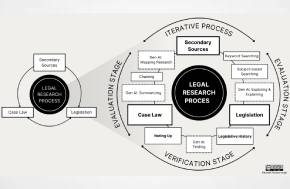
Integrating Generative AI into the Legal Research Process
Generative AI is now embedded in all three major legal research platforms. I understand the temptation to begin a search using these tools, particularly if a written hypothetical or clear fact pattern is provided. However, regardless of where the legal research process starts, generative AI can only supplement the existing legal research process. Traditional methodology and legal research skills are still essential. This visual displays points where generative AI can be integrated into the legal research process as an assistive tool.
The expanded legal research process highlights where the essential processes of evaluation and verification must occur, and maintains essential skills like subject-based searching, noting up, and completing a legislative history. This is meant to communicate that a researcher can flow back and forth between generative AI and traditional techniques and tools during their research process.
Read the full article and see relevant figures / graphics