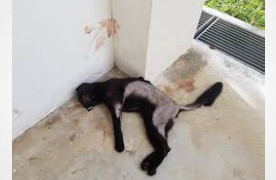
SINGAPORE – In the space of less than a week, two community cats have died.
One was found on the road near an estate in Yishun on May 9, disembowelled and with its eyes gouged out.
Another was discovered to be severely injured in a carpark in Punggol on May 12. Cat rescuers took the feline to a vet, but it eventually died from its injuries.
The National Parks Board said on May 17 that the cat had likely sustained its injuries due to a vehicular accident.
Nonetheless, the two incidents sparked outrage among members of the public, with some going to the extent of hiring a private investigator to catch the perpetrator.
In 2024, the Society for the Prevention of Cruelty to Animals (SPCA) received 961 reports of animal cruelty and welfare concerns involving 2,190 animals – numbers which hit a 12-year-high.
More than half of these were cats, with 1,330 cases
Given the spike in animal abuse cases, is it time to re-examine the law and implement harsher penalties?
Limitations of the law
Under the Animals and Birds Act, first-time offenders convicted of animal cruelty can be jailed for up to 18 months, fined up to $15,000, or both.
Repeat offenders can be jailed for up to three years, fined up to $30,000, or both.
Despite the large number of reported cases, very few are taken to the courts, said criminal lawyer Josephus Tan, who represented a man who threw a cat over the 13th-floor parapet of his block in Yishun Ring Road in 2016.
On Feb 7, Barrie Lin Pengli was sentenced to 14 months’ jail for abusing five cats and killing two of them over a period of one year and eight months. The prosecution, which originally sought a jail term of 24 months, appealed against the sentence on Feb 11.
“There is still a disproportionate number of cats killed compared with perpetrators who are arrested and charged. Optically, it looks very bad because it seems to suggest that (society) does not value the lives of animals,” said Mr Tan.
Head lawyer Gloria James of law firm Gloria James-Civetta & Co told The Straits Times there are several limitations to the current laws when it comes to prosecuting and sentencing offenders.
“A significant challenge is that animals are voiceless and cannot plead their case, which makes it difficult to gauge the extent of their suffering. This can impact the ability to impose a punishment that truly reflects the harm caused.”
Associate Professor Razwana Begum Abdul Rahim, who heads the public safety and security programme at the Singapore University of Social Sciences, said cases of animal abuse often lack direct evidence or credible witnesses.
“CCTV footage is rare, and animal carcasses may be disposed of before analysis can occur,” she said.
“The time lapses between the act of abuse and its reporting can also diminish the strength of cases and make it difficult to arrest and charge suspects.”