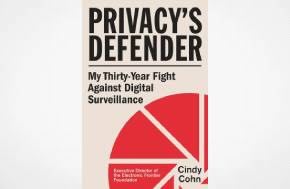
Cindy Cohn’s work as a civil liberties lawyer is guided by a simple idea: “When you go online, your rights go with you.”
Judging by her inspiring new memoir, her powerful opponents in Washington don’t agree.
Privacy’s Defender: My Thirty-Year Fight Against Digital Surveillance
By Cindy Cohn
(MIT Press; 248 pages; $29.95)
“Privacy’s Defender: My Thirty-Year Fight Against Digital Surveillance” arrives in stores as Cohn prepares to step down as executive director of the Electronic Frontier Foundation, a nonprofit organization based in San Francisco renowned for championing internet rights.
As a veteran of groundbreaking federal cases on free speech and other cherished civil liberties, her characterization of the mid-2020s as “a dark time for privacy” demands special attention.
Today, the White House controls “government agency databases that contain personal information about tens of millions of people,” she writes. Meanwhile, “ubiquitous camera networks” and specialized software have given D.C. “more power to surveil than ever before.”
Her book is a buoyant response to a dismaying moment, proof that a scrappy nonprofit can compel the government to follow the law. She combines an accessible account of cases she argued with a humble appeal for help from lawyers, writers and others who share her belief that “privacy is a crucial check on power.”
Cohn made her name by representing Daniel Bernstein, a UC Berkeley grad student in a legal fight with the government. Bernstein sought to publish computer code for an encryption program. The Department of Justice tried to stop him, citing a little-known part of a weapons law concerning the export of “rocket launchers, grenades and chemical weapons,” Cohn writes. “In the early 1990s it also included encryption software, specifically ‘software capable of maintaining secrecy.’” Publication of the software would make it viewable abroad, the government contended, making it an illegal export.
She counterargued that computer code is a form of protected speech. After a federal judge agreed, many of the contested restrictions were lifted. It was a win for those developing encryption tools and the web users who are protected by them.
At the dawn of the internet era, Cohn writes, the case showed how “a little band of lawyers and computer scientists could explain this new, complicated world to the courts.”