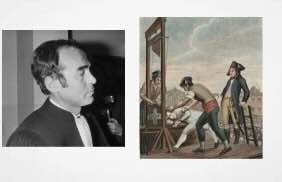
Robert Badinter, the former lawyer and justice minister who persuaded France to give up the guillotine, will be laid to rest in the Panthéon on October 9, the anniversary of the 1981 abolition of the death penalty. As he enters the Paris mausoleum to the heros of the French Republic, his legacy continues to inspire the global fight against capital punishment.
Robert Badinter, the lawyer, academic and former justice minister who spearheaded France’s historic abolition of the death penalty, will be honoured at the Panthéon on October 9 – 44 years to the day after the landmark bill he authored was signed into law.
Badinter, who died in February 2024 at the age of 95, will join Victor Hugo, Marie Curie, Simone Veil and other illustrious citizens buried in the vast domed mausoleum that dominates the Left Bank of Paris.
The late minister embodied France’s fight against capital punishment. His eloquent plea before the National Assembly on September 17, 1981, marked a turning point in modern French history.
“Tomorrow, thanks to you, French justice will no longer be a justice that kills,” he told French lawmakers. “Tomorrow, thanks to you, there will no longer be, to our common shame, furtive executions at dawn, under the black canopy, in French prisons. Tomorrow, the bloody pages of our justice will be turned.”
Members of the National Assembly duly passed his bill the next day, followed weeks later by the French Senate. On October 9, the guillotine was officially consigned to the history books.
A personal battle
Although Badinter had long opposed the death penalty, his fight became personal in November 1972 when he witnessed the execution at dawn of his client Roger Bontems. Convicted for his role in a deadly hostage-taking at Clairvaux prison, Bontems had been cleared of murder – but was still sentenced to the guillotine.
“Bontems was dead. I had seen Bontems go to his death. I had seen a man I defended die. Never again could I do anything for him. You don’t plead for the dead. The lawyer for a dead man is someone who remembers, nothing more,” Badinter later wrote in his memoir “The Execution”.
Witnessing his client’s execution was a turning point for Badinter, transforming his opposition to the death penalty into committed activism.