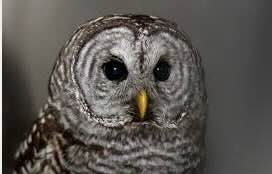
The US Senate has rejected legislation halting the U.S. Fish and Wildlife Service (USFWS) Barred Owl Management Strategy (Strategy) set forth in its August 2024 Record of Decision (ROD), which aims to protect endangered northern and California spotted owls in Washington, Oregon, and California by killing half a million invasive barred owls.
At issue – Is it ethical to actively manipulate nature through lethal methods, and if so, under what circumstances? The USFWS decision vividly illustrates this dilemma.
Invasive Species or Natural Competition?
The Barred Owl (Strix varia) is larger than the Northern Spotted Owl (Strix occidentalis caurina) and its counterpart, the California Spotted Owl (Strix occidentalis occidentalis). Barred Owls are common in eastern North American forests, easily recognized by their large dark eyes, yellow beak, and bright circular face with a brown barring pattern on white plumage.
The smaller and darker plumaged Northern Spotted Owl is an iconic symbol of old-growth forests in the Pacific Northwest and southwestern Canada. This species has lost much of its historical western range to logging, wildfires, and land development, leading to its listing as threatened under the US Endangered Species Act (ESA) in 1990.
The plight of the Northern Spotted Owl has grown more dire with the westward expansion of the Barred Owl. Once restricted to eastern North America, the Barred Owl has gradually expanded its range across the Great Plains during the twentieth century as fire suppression, tree planting, and land-use change created wooded corridors connecting eastern and western forests. Its arrival in the Pacific Northwest—now extending into northern California—has brought intense competition for food and nesting habitat. The most comprehensive study to date suggests the presence of Barred Owls within Spotted Owl territories reduces survival and recruitment, resulting in annual population declines between 2 and 9 % 1.
Ecologists are divided over whether the Barred Owl’s arrival in the Pacific Northwest is natural range expansion or a human-mediated biological invasion. Some argue that the species’ expansion is consistent with natural colonization2. Others contend that anthropogenic factors such as fire suppression, agricultural abandonment, shelterbelt planting, and urban tree growth have fundamentally altered the Great Plains corridor, enabling a rapid, human-assisted westward movement of Barred Owls3. This distinction is not merely semantic; it determines whether interventions, such as large-scale lethal removal of Barred Owls, are seen as ecological restoration or as artificial manipulation of natural evolutionary dynamics. This ambiguity lies at the heart of the management dilemma confronting conservationists and the USFWS.
A Lethal Plan
In its Strategy, USFWS adopts the view that this is primarily a human-caused biological invasion, classifying the Barred Owl as a non-native, invasive competitor within the Spotted Owl’s natural range. The synthesis of several long-term population studies in the Service’s 2024 final Environmental Impact Statement (EIS) concludes that Spotted Owl populations decline sharply in areas occupied by Barred Owls, particularly where the two species have coexisted for a decade or more4.
In its ROD, USFWS has chosen to remove by lethal means (culling) up to 450,000 Barred Owls from Spotted Owl habitat alongside habitat protection and monitoring to help Spotted Owl recovery5. USFWS will issue permits under the Migratory Bird Treaty Act (MBTA) to designated federal, state, tribal, and private landowner “removal specialists” trained and authorized to lethally remove Barred Owls in specific management areas where Spotted Owls and Barred Owls share habitat. The chosen alternative does not allow public hunting of Barred Owls.
The strategy is justified by the results of experimental management projects conducted between 2009 and 2021, which tested whether lethal removal of Barred Owls could slow or reverse the decline of Spotted Owls. The research confirmed Barred Owls exclude Spotted Owls from territories through aggressive displacement and resource competition. Removing Barred Owls significantly improved Spotted Owl survival and slowed population decline. Habitat protection alone was insufficient for protecting Spotted Owl populations in unmanipulated control areas.
An Ethical Dilemma
One of the most contested ecological and ethical issues in North American conservation is whether the Barred Owl’s expansion into the Pacific Northwest constitutes a natural range shift or an invasion facilitated by human activities. When does the expansion of a species’ home range become an invasion? Would ecological conditions have evolved differently if not for human intervention?
The ethical dilemma arises because the plan effectively involves killing one species to save another. It’s a trade-off that many conservation ethicists find deeply troubling. Critics argue the Barred Owl, although now widespread in the Pacific Northwest, is still a native North American species. Framing the Barred Owl as invasive overlooks the human-induced habitat changes that encouraged its inherent natural behavior, leading to westward expansion.
At the heart of the USFWS Strategy debate is the conflict between the moral standing of individual animals (each Barred Owl that would be killed) and species-level conservation goals (the recovery of the threatened Northern Spotted Owl). It reflects a fundamental tension between two ethical frameworks: animal ethics or welfare and environmental ethics.
From an animal ethics or welfare perspective, every Barred Owl has intrinsic moral value, meaning each bird possesses the right not to be harmed unnecessarily, regardless of its species or ecological role. Deliberately killing Barred Owls—potentially 450,000 birds over 30 years—to benefit another species raises profound concerns about cruelty, proportionality, and the ethics of valuing some lives over others. This perspective demands that all non-lethal options (e.g., translocation, habitat management, contraception, and other deterrents) should be exhausted before resorting to lethal means.
From an environmental ethics standpoint, the moral priority lies in the integrity, stability, and resilience of the ecosystem. The Northern Spotted Owl is a keystone indicator of the health of ancient forest ecosystems in the Pacific Northwest. Its extinction would represent an irreversible loss of evolutionary history, ecological function, and cultural symbolism. Actions that harm individuals can be morally justified if they preserve the greater biotic community or aim to prevent the extinction of a species. Thus, removing Barred Owls can be viewed as an act of ecological restoration or moral repair for the human-caused imbalance.
Another dimension of the controversy concerns efficacy, unintended consequences, and long-term feasibility. Opponents argue that the large-scale culling plan, spanning decades and hundreds of thousands of animals, is unproven and may delay, rather than prevent, the extinction of the Spotted Owl. Moreover, some contend that the root causes of the Spotted Owl’s decline (habitat destruction, forest fragmentation, and climate change) have not changed. Focusing on predator removal without comprehensive habitat restoration may be a form of “conservation triage” rather than full ecological recovery.
The Strategy prompts reflection on human responsibility for habitat destruction and climate change, as well as the potential limits of so-called nature-based solutions6. The deliberate removal of large numbers of one wildlife species to benefit another challenges traditional conservation ethics and raises questions about precedent, fairness, and the rights of so-called invasive species.
References
- Franklin et al. (2021). https://doi.org/10.1016/j.biocon.2021.109168
- Monahan and Hijmans. (2007). https://www.jstor.org/stable/40166898.
- Livezey (2009a). https://doi.org/10.1674/0003-0031-161.1.49; Livezey (2009b). https://doi.org/10.1674/0003-0031-161.2.323.
- US Fish and Wildlife Service (2024a). https://www.fws.gov/sites/default/files/documents/2024-07/final-eis-barred-owl-management-strategy.pdf; Long et al. (2019). https://doi.org/10.1002/jwmg.21715.
- US Fish and Wildlife Service (2024b). https://www.fws.gov/sites/default/files/documents/2024-08/2_final_rod_boms_8.19.2024_508_signed.pdf.
- Waldkoenig. (2025). https://doi.org/10.1080/21550085.2025.2555695.