Report to Congressional Committees
May 2026
GAO-26-107816
United States Government Accountability Office
Highlights
A report to congressional committees
For more information, contact: Derrick Collins at CollinsD@gao.gov
What GAO Found
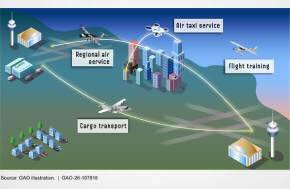
Manufacturers are developing fully electric and hybrid-electric aircraft, mostly for short-range and medium-range flying. These aircraft vary widely in design. Some require a runway for takeoff, while others take off vertically, for example, from the top of a building. They also have a wide variety of potential uses, including air taxi service and cargo transport. The Federal Aviation Administration (FAA) and other entities have also researched technologies that could potentially enable longer-range uses and broader deployment of electric aircraft in the future.
Examples of Potential Uses for Electric Aircraft
The infrastructure to support electric aircraft at U.S. airports is currently limited. According to FAA, as of December 2025, 47 airports have identified charging stations for electric aircraft in airport plans. The majority of these airports are part of the manufacturer BETA Technologies’ network of charging stations. According to FAA officials and selected stakeholders, airports face a variety of challenges related to installing infrastructure for electric aircraft, including cost, uncertainty about demand, and availability of reliable electricity.
As of March 2026, FAA is evaluating electric aircraft and engine designs for certification on a case-by-case basis, but is considering regulatory changes, such as developing dedicated airworthiness standards for electric vertical takeoff and landing aircraft, that could standardize its approach to evaluating these products in the long term. Stakeholders described challenges with FAA’s approach, including insufficient FAA staff with expertise in electric propulsion and limited standardization in the certification process. According to FAA officials, they have hired engineers in disciplines such as propulsion, and deployed experienced personnel as needed to emerging technology areas. However, ensuring that planned skill gap assessments are quantitative and include all mission-critical occupations, as GAO recommended in 2021, would help FAA better understand the skills its workforce needs to respond to technological changes.
Why GAO Did This Study
Electric propulsion aircraft have the potential to lower operating costs, increase access to air service for regional airports, and reduce environmental impacts and noise from aviation. However, FAA has not yet issued a type certification for a manned electric aircraft as of March 2026, and when such aircraft will be able to commercially operate is not clear.
Section 1012 of the FAA Reauthorization Act of 2024 includes a provision for GAO to assess the safe and scalable operation and integration of electric aircraft into the National Airspace System.
This report describes (1) the types and uses of electric aircraft in development; (2) the extent of infrastructure deployed at U.S. airports to support electric aircraft, and any challenges airports face in deploying infrastructure; and (3) FAA’s approach to certificating the airworthiness of electric aircraft designs, and related challenges identified by aviation industry stakeholders. GAO analyzed literature on electric aircraft published between 2019 and 2024 and used information from these studies to supplement testimonial evidence from interviews with aviation industry stakeholders and federal officials. GAO also analyzed public information on government and industry efforts to develop electric aircraft. GAO interviewed officials from FAA, the National Aeronautics and Space Administration, the National Laboratory of the Rockies, and a nongeneralizable selection of 30 aviation industry stakeholders, including aircraft and engine manufacturers, airports, fixed-base operators, state departments of transportation, and a flight training school. Eight interviews were conducted as part of site visits to Washington State and Ohio.
Abbreviations
| AAAE American Association of Airport Executives |
| ARAC Aviation Rulemaking Advisory Committee |
| ARMD Aeronautics Research Mission Directorate |
| CAAT Center for Advanced Aviation Technologies |
| DOE Department of Energy |
| DOT Department of Transportation |
| eCTOL Electric conventional takeoff and landing (aircraft) |
| eIPP Electric Vertical Takeoff and Landing and Advanced Air Mobility Integration Pilot Program |
| eSTOL Electric short takeoff and landing (aircraft) |
| eVTOL Electric vertical takeoff and landing (aircraft) |
| FAA Federal Aviation Administration |
| FACA Federal Advisory Committee Act |
| NASA National Aeronautics and Space Administration |
| NLR National Laboratory of the Rockies |
This is a work of the U.S. government and is not subject to copyright protection in the United States. The published product may be reproduced and distributed in its entirety without further permission from GAO. However, because this work may contain copyrighted images or other material, permission from the copyright holder may be necessary if you wish to reproduce this material separately.
Letter
May 27, 2026
The Honorable Ted Cruz
Chairman
The Honorable Maria Cantwell
Ranking Member
Committee on Commerce, Science, and Transportation
United States Senate
The Honorable Brian Babin
Chairman
The Honorable Zoe Lofgren
Ranking Member
Committee on Science, Space, and Technology
House of Representatives
The Honorable Sam Graves
Chairman
The Honorable Rick Larsen
Ranking Member
Committee on Transportation and Infrastructure
House of Representatives
Electric propulsion aircraft vary widely in design, but all employ electric power rather than fuel combustion as their primary source of propulsion. Among other potential benefits, electric aircraft could lower operating and maintenance costs for aviation businesses, increase access to air service for regional airports, and reduce the environmental impact of aviation, according to several recent studies.[1] Although several manufacturers have made progress toward certification in recent years, the Federal Aviation Administration (FAA) has not issued a type certification for a manned electric aircraft, and it is not clear how soon such aircraft will be able to commercially operate in the National Airspace System.
Section 1012 of the FAA Reauthorization Act of 2024 includes a provision for GAO to assess the safe and scalable operation and integration of electric aircraft into the National Airspace System. The act includes provisions on, among other things, the technical capacity and competencies needed in the FAA workforce to certificate electric aircraft, and the airport infrastructure required to support electric aircraft operations.[2]
This report describes (1) the types and use cases of electric aircraft in development; (2) the extent of infrastructure deployed at U.S. airports to support electric aircraft, and any challenges airports face in deploying infrastructure; and (3) FAA’s approach to certificating the airworthiness of electric aircraft designs, and any related challenges identified by aviation industry stakeholders.[3]
For all three objectives, we analyzed publications on electric aircraft published between 2019 and 2024. We identified these publications by searching databases, including ProQuest, EBSCO, Scopus, and Dialog, for key words such as “electric” or “hybrid-electric” aircraft, “regional air mobility,” and “electric infrastructure.” On the basis of this review, we identified 19 studies that discussed relevant policy and technical issues related to electric aircraft and their supporting infrastructure. We used information from these studies to supplement testimonial evidence from interviews we conducted with aviation industry stakeholders and federal officials, as described below. We also analyzed public information on government and industry efforts to develop electric aircraft and supporting infrastructure, including manufacturers’ annual reports; National Aeronautics and Space Administration (NASA) and the Department of Energy’s National Laboratory of the Rockies (NLR)[4] reports on electric propulsion research; FAA rulemaking documents on certification; and reports on Advanced Air Mobility, which includes electric aircraft.[5]
To describe the extent of infrastructure deployed at U.S. airports to support electric aircraft and related challenges, and FAA’s approach to certificating the airworthiness of electric aircraft designs, we interviewed officials from FAA, including staff from two Airport District Offices and FAA’s West, Central, and East Certification Branches. We also interviewed officials from NLR, NASA, and a nongeneralizable selection of 30 aviation industry stakeholders, which included representatives from aircraft and engine manufacturers, airports, fixed-base operators, state departments of transportation, and a flight training school.[6] See appendix I for the list of aviation industry stakeholders we interviewed. We selected these stakeholders based on the following criteria: representation of different airport sizes and aircraft designs, state-level aviation programs supporting electric aircraft, and geographic diversity. We conducted eight of these interviews as part of site visits to Washington State and Ohio.
We conducted this performance audit from September 2024 to May 2026 in accordance with generally accepted government auditing standards. Those standards require that we plan and perform the audit to obtain sufficient, appropriate evidence to provide a reasonable basis for our findings and conclusions based on our audit objectives. We believe that the evidence obtained provides a reasonable basis for our findings and conclusions based on our audit objectives
Electric aircraft differ from conventional aircraft in that they use battery-powered electric motors—rather than fuel combustion engines—to fully or partially drive the aircraft’s propellers or turbines. See fig. 1.
Full report