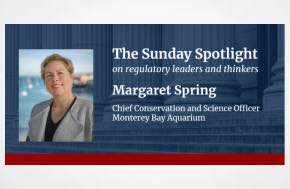
Margaret Spring discusses domestic and global efforts to reform plastics regulation.
In a discussion with The Regulatory Review, Margaret Spring discusses national and global efforts to reform plastics regulation.
Spring identifies the risks that plastics pose for marine ecosystems and human health and their disproportionate effects on countries in the global south. Drawing upon her research and advocacy experience, she shares her perspective on some of the most impactful global and domestic reform strategies that governments and international bodies can use to reduce or eliminate plastics pollution and its harmful downstream effects.
Margaret Spring is the chief conservation and science officer at the Monterey Bay Aquarium. Alongside this role, she serves as a board member of the California Ocean Science Trust, a founding board member of the Monterey Bay Fisheries Trust, and the chair of the National Academies of Sciences, Engineering, and Medicine’s Committee on United States Contributions to Global Ocean Plastic Waste. Spring has represented both the Aquarium and the International Science Council in ongoing negotiations for a global UN treaty on plastics pollution.
Previously, Spring was chief of staff and principal deputy undersecretary for oceans and atmosphere at the National Oceanic and Atmospheric Administration. During her time in Washington, D.C., she also served as general counsel to the U.S. Senate Committee on Commerce, Science, and Transportation and worked as an environmental attorney at Sidley & Austin.
The Regulatory Review: What risks do plastics pose to marine ecosystems and human health?
Margaret Spring: In 2020, I chaired a National Academies of Sciences, Engineering, and Medicine committee that documented the toll of plastic pollution on ocean wildlife—from entanglement deaths to reduced fertility and growth—and found that the United States generates more plastic waste than any other country, at 287 pounds per person each year. The 2022 report also found that single-use items were a major source of this plastic waste.
New research also shows that plastic harms human health across the full life cycle of plastics, from extraction to disposal. These harms fall disproportionately on vulnerable populations, including workers and children, and exposure to the chemicals in plastics in the womb can have devastating lifelong effects.
Read full article