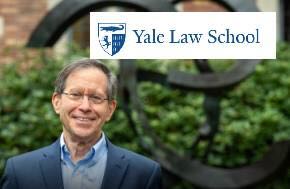
After 50 years on the Yale Law School faculty, Professor Paul Gewirtz retired on July 1, becoming the Potter Stewart Professor Emeritus of Constitutional Law. An esteemed scholar and much-admired teacher, he has written and taught in multiple legal and policy fields, including constitutional law, antidiscrimination law, federal courts, U.S. foreign policy and law, U.S.-China relations, Chinese law, comparative law, law and literature, and arts and the lawyer.
Gewirtz has also stepped down as the Director of the groundbreaking Paul Tsai China Center, one of two major Law School institutions Gewirtz founded as a professor, the other being the Global Constitutionalism Seminar. As Professor Emeritus, Gewirtz will remain active part-time at the Law School, and will become Founding Director and Senior Fellow at the Paul Tsai China Center. His successor as the Center’s director is Professor Odd Arne Westad, Elihu Professor of History and Global Affairs at Yale University.
Gewirtz founded the Center in 1999 as The China Law Center, with an unusual origin. In 1997 and 1998, Gewirtz was on leave from Yale Law School and was a part of President Bill Clinton’s ’73 administration, where he served as Special Representative for the Presidential Rule of Law Initiative. In that post, he developed and led the U.S.-China initiative to cooperate in the legal field that President Clinton and China’s President Jiang Zemin agreed to at their 1997 and 1998 Summit meetings.
- Read more: “The U.S.-China Rule of Law Initiative,” William & Mary Bill of Rights Journal (2003).
After returning to Yale Law School, he founded The China Law Center, convinced that the U.S. government was not the best entity to implement the Summit agreement.
Under Gewirtz’s leadership, Yale Law School and the Center quickly moved ahead with research and teaching on legal development in China, and, most distinctively, launched a variety of cooperative projects with Chinese counterparts. This was a period when China was seriously focused on developing its laws and legal system, and the Summit agreement enabled Chinese experts at major Chinese law schools and in the government to work with U.S. experts to make major advances. The China Law Center rapidly became a U.S. leader in playing that role and contributed significantly to major legal reforms in the fields of administrative law, judicial reform, criminal law, and others. The Center’s legal exchanges and research continue today on many new fronts, such as AI regulation, international law including law of the sea, sex discrimination, juvenile justice, and constitutional law. The Center also undertakes cutting-edge research on historical, philosophical, and economic aspects of legal development in China.

What came to be named the Paul Tsai China Center also gradually became deeply engaged in evolving issues of U.S.-China relations, and the Center’s staff and Yale Law School students became more involved in fundamental foreign policy issues as well as legal issues. This combination, according to Gewirtz, is in the traditions of both the United States and Yale Law School.
“Lawyers have traditionally played central roles in U.S. foreign policy leadership issues as government officials, beginning with Thomas Jefferson as secretary of state and Alexander Hamilton as secretary of the treasury,” Gewirtz said. “Generations of Yale Law School graduates and students strongly continue this tradition of U.S. foreign policy leadership in law school and during their careers.”
The Center’s focus on the U.S.-China relationship has involved research, teaching, and a variety of projects and other activities with people and institutions in both the United States and in China, including the U.S. government. The Center’s staff meets regularly with a range of top experts from Chinese universities and elsewhere, with the goal of improving understanding on both sides, clarifying differences, exploring whether they can be narrowed, and exploring possibilities for more constructive policies and even areas of cooperation. These interactions include leading and participating in “Track II Dialogues” with Chinese counterparts that bring together former senior government officials and top experts from both countries to address a broad range of issues in the U.S.-China relationship: technology, trade policy, Taiwan, military issues, Asia-Pacific regional security issues, the future of the international order, human rights policies, and more. In addition, recognizing the long U.S. practice of working with allies and partners, Center experts work with experts in several countries, especially in Europe. The Center also has a Visiting Scholar program and hosts many public events with outside expert speakers.
“The goal of the Center’s work is not only to have exchanges and explore some immediate practical impact if possible, but also to enhance the important scholarship that Paul Tsai China Center’s staff produces,” Gewirtz said. “This writing addresses a large range of legal and policy issues, and also history related to these matters and how that history can improve understanding of the present.”

Yale Law School students are a central and major part of the Paul Tsai China Center’s activities. Through the center’s robust student program, law students collaborate with Center staff on existing activities and projects and also create their own, further enhancing the work of the Center. Students also use their involvement in the Center to develop and write their own articles and contribute to other Law School work.
Gewirtz often tells his students: “You are not the ‘next generation’ in U.S.-China relations. You’re an extremely important ‘current generation’ that can have a significant effect now.”
Since current students have come of age with AI, Gewirtz said, they often know more about it than many of their elders. They can often undertake first-tier discussions and writing about AI, including issues of AI regulation and emerging U.S.-China AI competition. But Gewirtz emphasized that as official relations between the United States and China have worsened and contact between government officials and other elders has lessened, students have an opportunity.
“Students can build distinctively valuable channels of candid communication with Chinese counterparts today — channels that improve mutual understanding, often can more easily examine issues of sensitivity and danger together, and yield significant research,” Gewirtz said.
In recent years, the Paul Tsai China Center has organized Zoom “dialogues” between students at universities in China and students at Yale Law School, often lasting several months. These “dialogues” involve sustained exchanges about substantive issues and also create broader channels of communication. In the period ahead, the Paul Tsai China Center will undertake more in-person student exchanges, including Law School student trips to China and Taiwan that focus on particular issues and enable students to meet and have discussions with experts and students engaged in these issues.
The work of the Paul Tsai China Center has been possible because of landmark gifts from Yale Law School alumnus Joseph Tsai, B.A. ’86; J.D. ’90, in honor of his father, Yale Law School alumnus Dr. Paul C. Tsai, LL.M ’54, J.S.D. ’57. The Law School is deeply grateful that these gifts have made it possible for Center to do its important work under the leadership of Professor Gewirtz, and now to continue its work into the future under the leadership of Professor Arne Westad.