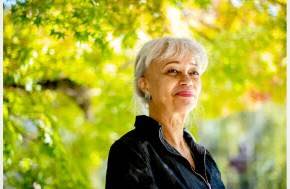
Many people think of Patricia Williams as a constitutional lawyer.
The university distinguished professor of law and humanities has spent decades integrating seemingly disparate areas of the law, including race, property interests and the legacy of slavery; the biotech revolution in healthcare; and, more recently, how algorithms and AI systems shape our understanding of ourselves and our lives.
But Williams, who also directs the Law, Technology and Ethics Initiatives, has long thought of herself differently. Fundamentally, she is a contracts law expert, focused on an area of the law concerned with how people or private parties formalize their contractual obligations to each other.
“I’ve really written about contracts; what I think and talk about are the limits of contracts,” Williams told Northeastern Global News.
Her interest in contracts began in the 1980s, when she was working as a consumer protection advocate in California, focusing on corrupt home equity loans and other areas of health law. Having taught for some time in Wisconsin — “a good dairy state,” she said — Williams found herself frequently tending to contracts for the sale and maintenance of pigs, cows and other large mammals.
All of that, she said, was happening against the backdrop of a growing national debate over reproductive rights and medical ethics, as the first major surrogacy dispute — called the “Baby M” case — probed questions about the ways in which contracts govern the creation of life. It was then she began to take an interest in how contracts “intersect with the health and welfare of bodies.”
It wasn’t long after that case that Williams turned to race, penning a seminal essay titled “On Being the Object of Property.” In it, Williams argues that the legacy of slavery — and “slave law” — continues to shape Black identity and conceptions of legal personhood in America by thoroughly examining the law’s treatment of Black bodies.
Williams, who arrived at Northeastern seven years ago, has since spent a career in law focused on surrogacy, civil rights, climate change and now, increasingly, technologies, including artificial intelligence, which is reshaping questions of identity, autonomy and legal rights. She also writes prolifically for such publications as the New York Times, the New Yorker and the Nation, where she was a columnist for many years.
Now, she has earned another accolade. Williams has been elected to the American Academy of Arts & Sciences, an honorary society and research center that brings together leading academics from across disciplines in an effort to solve complex problems.
She joins 252 other distinguished academics across the arts, industry, journalism, philanthropy, policy, research and science, who comprise this year’s inductees.