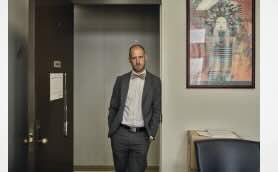
Noah Cox, a lawyer in the Los Angeles County Public Defender’s Office, formed the neurocognitive disorder team built on the premise that prison is not always the right place for someone with this kind of disability.
Philip Cheung for NPR
A few years ago, Noah Cox noticed something about some of the people he represented in court. They struggled to communicate, think logically or problem solve.
“I wanted to know their account of what happened, and I’d ask them questions. And many of them would struggle with a basic explanation,” says Cox, a lawyer in the Los Angeles County Public Defender’s Office. “It seemed like they were having challenges related to some sort of intellectual ability.”
What Cox was seeing was indicative of a broader trend: Studies show people with intellectual and developmental disabilities are overrepresented in the nation’s prisons and jails.
He set out to break that pattern, forming a team within the public defender’s office known as the neurocognitive disorder team. It’s a pioneering effort built on the premise that prison is not always the right place for people with these types of disabilities.
‘A cycle of being involved in the system’
There are many reasons why someone might experience a cognitive impairment, including conditions such as Fetal Alcohol Syndrome, Down Syndrome, a traumatic brain injury, or an intellectual disability, which can limit learning and everyday tasks.
But many of Cox’s clients were never diagnosed with any sort of disability. That doesn’t surprise Leigh Anne McKingsley, senior director of disability and justice initiatives for The Arc, a nonprofit that advocates for people with intellectual and developmental disabilities.
“Often the disability goes unrecognized,” McKingsley says. “They could have gone through their school system not ever really passing much, but it never got documented.”