Let’s start with LawSites, Ambrogi has a better handle than most on explaining these things..
He uses long words which won’t confuse our readers but sure as hell won’t mean anything to people in markets.
I’ll highlight the most relevant parts.
Sadly it’s about dull old legal workflow stuff. But as i have been saying for years if the research companies stuck with what they know best – legal materials and working on the research side of things rather than going for the mega orgasm they might not have landed themselves in this position.
Since about 2013 they decided they were legal software and tech companies not publishers and they got the goldrush money but now the crows are coming home to roost and tech by its very nature has outsmarted them.
Although they have built and improved research they did not invest in time, money and most importantly in people who like to think outside the box and they could well be fucked.
They’ll lose in the tech game and i believe their decline in research and understanding text has been on the wane for years and it won’t be long before another shock comes along in the research field to further fuck them.
Quite honestly it is about time.
The death will be slow and it will be a pleasure to watch.

None of these great minds leading these companies bothered to pick up a copy of this

It might be a bit old school but it tells the timeworn story of American corporations and their leaden footed leaders being pummelled into insignificance.
Ambrogi writes
To read today’s news, you’d think it was the shot heard ’round the world — or around the legal tech world, at least.
“Legal software companies have suffered sharp declines in their share prices,” reports The Guardian. “Anthropic’s Move Into Legal, Data Services Sinks Software Stocks,” says Bloomberg. “A selloff in … stocks…
To read today’s news, you’d think it was the shot heard ’round the world — or around the legal tech world, at least.
“Legal software companies have suffered sharp declines in their share prices,” reports The Guardian. “Anthropic’s Move Into Legal, Data Services Sinks Software Stocks,” says Bloomberg. “A selloff in … stocks deepened on Tuesday after new artificial intelligence models raised concerns over the potential impact on sectors once seen as AI beneficiaries,” Reuters reports.
The catalyst of this market panic is a rather simple plugin launched last week on Github by Anthropic, the company behind the artificial intelligence platform Claude.
Two weeks after introducing a new general-purpose “agentic” work mode called Claude Cowork, Anthropic has now rolled out a legal plugin aimed squarely at the legal workflows of in-house counsel, including contract review, NDA triage, compliance checks, briefings and templated responses.
It is configurable to an organization’s own playbook and risk tolerances, and Anthropic explicitly frames it as assistance, not advice, cautioning that outputs should be reviewed by licensed attorneys.
It may sound like just another feature drop in a crowded AI market. But for legal tech, it is landing more like a tsunami than a drop. For the first time, a foundation-model company is packaging a legal workflow product directly into its platform, rather than merely supplying an API to legal-tech vendors.
And the legal tech market is taking notice.
A Plugin for Cowork
If you are not familiar with Cowork, Anthropic launched it Jan. 12 as an extension of Claude Code, a previously released tool designed to be used by developers for coding.
Anthropic positions Cowork as “Claude Code for the rest of your work,” with an interface designed to feel less like chat and more like assigning tasks to a colleague.
You give it access to a folder on your computer, and it can read, edit and create files in that workspace while it plans and executes multi-step tasks.
It runs on your computer and executes work in a virtual machine environment, providing security and ensuring it operates within boundaries you define.
A Suite of Specialized Plugins
What has the legal tech world buzzing is that, on Jan. 30, Anthropic added a suite of plugins to Cowork designed to turn it from a generalist tool to a specialist for specific purposes or functions.
Specifically, Anthropic open-sourced 11 “starter” plugins and published them on GitHub as templates that companies can customize. They cover various tasks such as marketing, finance, customer support and sales — and among them is one for legal.
As TechCrunch summarized it, the idea is to automate specialized departmental work – including legal document review – using agentic workflows, and to let enterprises customize plugins without heavy technical lift.
The Legal Plugin
Anthropic’s legal plugin is, according to the description, designed to “speed up contract review, NDA triage, and compliance workflows for in-house legal teams.” I have not tried it, but, according to Anthropic, it can:
- Review a contract against your playbook: The prompt /review-contract runs a clause-by-clause review against a configured negotiation playbook, returning green/yellow/red flags and redline suggestions.
- Triage incoming NDAs: /triage-nda categorizes incoming NDAs for standard approval, counsel review, or full review.
- Other tasks: Check vendor agreement status with /vendor-check, generate contextual briefings with /brief (daily briefs, topic research, or incident response), and create templated responses for common inquiries like data subject requests and discovery holds with /respond.
“All outputs should be reviewed by licensed attorneys,” Claude cautions.
Unlike using Claude for general-purpose chat, this is closer to an actual workflow product for commercial legal work. In that sense, it treads the same terrain where many legal AI vendors have competed – sometimes by wrapping these very same foundation models with playbooks, clause libraries, redline suggestions and integrations.
The Github page adds that the legal plugin can connect to applications such as Slack, Box, Egnyte, Jira and Microsoft 365. Needless to say, those are all applications common to enterprise legal operations.
Enabled By MCP
Anthropic’s new plugins depend on MCP, or Model Context Protocol, which Anthropic introduced as an open standard for secure, two-way connections between AI tools and external systems and data sources.
For legal teams, MCP forms the bridge from AI that can simply draft text to AI that can draft text within the context of your matters, your documents, and your workflow triggers.
That is where the competitive bar starts to get interesting and where foundation-model vendors can start to look more like platform vendors, at least in legal.
The Legal Tech Market Reacts
Although the plugin may seem like a rather modest application in the scheme of things, its launch has sent shockwaves through the legal market.
An article today in The Guardian, Anthropic’s Launch of AI Legal Tool Hits Shares in European Data Companies, reported that the plugin’s launch resulted in sharp share-price drops among major European data, publishing and information-services companies, alongside a significant decline for Thomson Reuters shares in the U.S.
Reuters and Bloomberg had similar reports, describing the launch as the catalyst for steep declines in companies such as RELX and Wolters Kluwer.
Whether the sell-off was an overreaction is almost beside the point. It underscores the fear among established legal tech vendors that the foundation model companies can now ship targeted workflow automation tools directly into the enterprise – and potentially law firms as well.
A Pivotal Moment for Legal Tech?
One reason this is so potentially significant is that it signals that the foundation models such as Claude and ChatGPT are no longer just “plumbing” underlying legal AI products but rather potential competitors.
Many legal AI vendors have built their products on the “model + wrapper + workflow” model, assuming that the model layer remains a neutral player. But now Anthropic is effectively bundling its own “model + wrapper + workflow” – circumventing the legal vendor and going straight to the customer.
Added to that is the fact that Anthropic is bundling this legal plugin with others for sales, marketing, finance and other enterprise functions. For inhouse legal departments dealing with NDAs and sales contracts, that could translate to an effective and streamlined distribution channel for handling routine agreements from other corporate departments.
Last but not least, Anthropic’s plugin is open source. That means corporate legal ops professionals can customize and build on the plugin to create something tailored to their needs – without waiting for a vendor to build out those features.
None of this eliminates the need for legal tech vendors. But it raises the bar to where wrappers + workflows alone may not be enough.
Is this a major threat to the industry? Well, not yet. It is, however, an opening salvo in what is likely to change the competitive landscape over the next couple of years.
Going forward, the big question might be just how much of an appetite Anthropic or other foundation companies have to compete in the legal tech market with more robust offerings – and how legal AI companies respond.
Meanwhile, legal tech vendors have one ace in the hole that the foundation companies cannot easily replicate, and that is the potent and powerful combination of proprietary datasets and subject-matter expertise.
They have the resources and know-how their customers need — and that legal AI needs. And that gives them the upper hand, at least for now.
– Linked In
https://www.linkedin.com/feed/update/urn:li:activity:7424530364993486848/
Seeing everyone “freak out” over the Anthropic Legal Plugin announcement but not sure why?
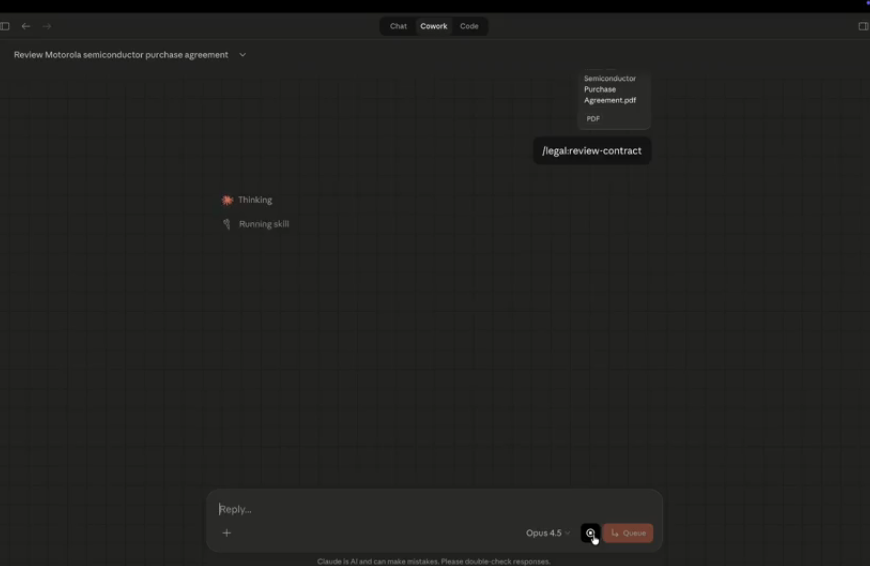
Watch me use it in Claude Cowork on MacOS for this contract review and then you will understand more.
This is just one of many “legal skills” that appear to be added through the plugin directly into the Claude desktop app.
Wish you could review the actual Microsoft Word output and compare it to the contract used?
If you want to see a copy of the agreement and final output, comment COWORK and I will send you a DM with the output word document and pdf agreement.
https://github.com/anthropics/knowledge-work-plugins
Watch him use it with some killer lift muzak to soundtrack the death of legal publishers
Killing me gently with his song ! is the new soundtrack for the legal publishers
Just click on the image
Tip Ranks
Resilient Westlaw Moat and Steady Growth Support Thomson Reuters Buy Rating
Canaccord Genuity analyst Aravinda Galappatthige has maintained their bullish stance on TRI stock, giving a Buy rating yesterday.
Aravinda Galappatthige has given his Buy rating due to a combination of factors tied to Thomson Reuters’ structural strengths and valuation. He argues that the new AI plug-ins from Anthropic are aimed at low-complexity, internal legal workflows and fall well short of the breadth, depth, and rigorous curation underpinning Westlaw, meaning little direct risk to TRI’s core legal clientele. He also highlights that only a modest slice of TRI’s revenue exposure lies in smaller firms where substitution risk is marginally higher and that courts, regulators, and major law firms will continue to demand the fully annotated, authoritative content suites TRI provides.
He forecasts steady financial performance, calling for high-single-digit organic growth led by the Big 3 segments, near-term EBITDA in line with Street expectations, and no change to the 2026 outlook of expanding margins and 7.5–8% organic growth. Despite trimming his target to $130 to reflect sector multiple compression, he underscores that TRI still trades at about a 5.3% free cash flow yield, has balance-sheet capacity for buybacks, and should compound value as management executes on the multi-year guidance, all of which warrant maintaining the Buy recommendation.
In another report released yesterday, TD Cowen also maintained a Buy rating on the stock with a C$285.00 price target.
Based on the recent corporate insider activity of 148 insiders, corporate insider sentiment is negative on the stock. This means that over the past quarter there has been an increase of insiders selling their shares of TRI in relation to earlier this year.
Artificial Lawyer
Claude Crash Impact on Thomson Reuters + LexisNexis is Irrational
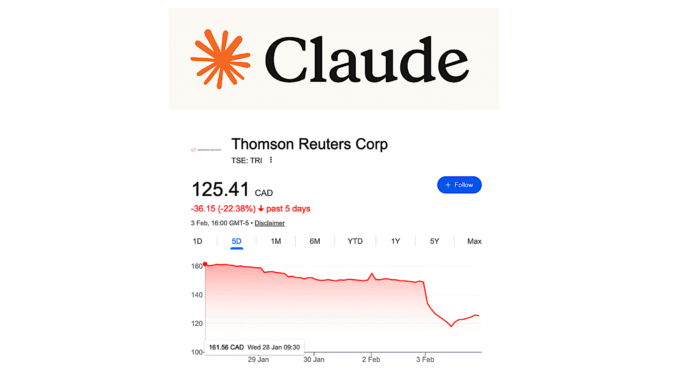
The share prices of Thomson Reuters, LexisNexis’s owner RELX, and Wolters Kluwer have experienced what AL is calling a ‘Claude Crash’, after Anthropic announced it was moving into legal tech. However, selling off shares in legal data titans seems an irrational response.
Let’s look at what has happened – and an important caveat, markets really are irrational and all the share prices of the companies mentioned here may have rebounded by the end of the day.
First the stock prices – as you can see, TR, RELX which owns Lexis, and WK, all saw major share price drops this week after the markets digested the news that Anthropic is offering a range of dedicated AI skills for legal – which AL covered on Monday morning – see here.
TR, for example, was down 22% compared to its price 5 days ago, with RELX by 20% – and you can clearly see the dip on all the charts from Feb 3rd, all happening at the same time.
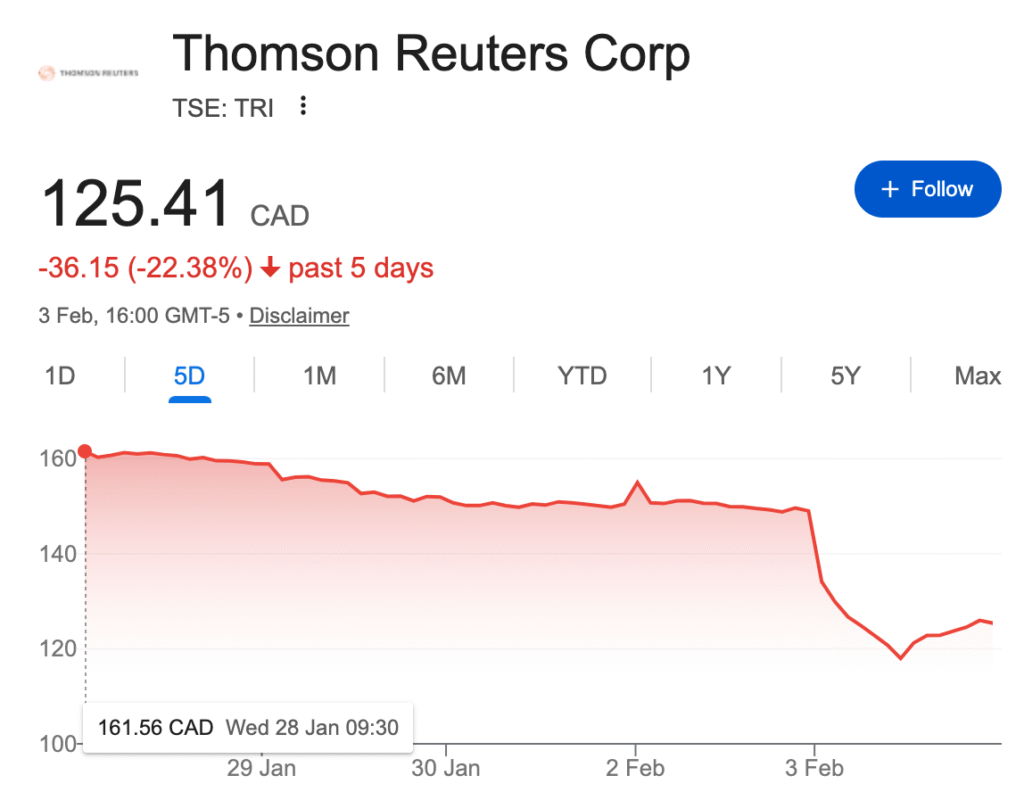
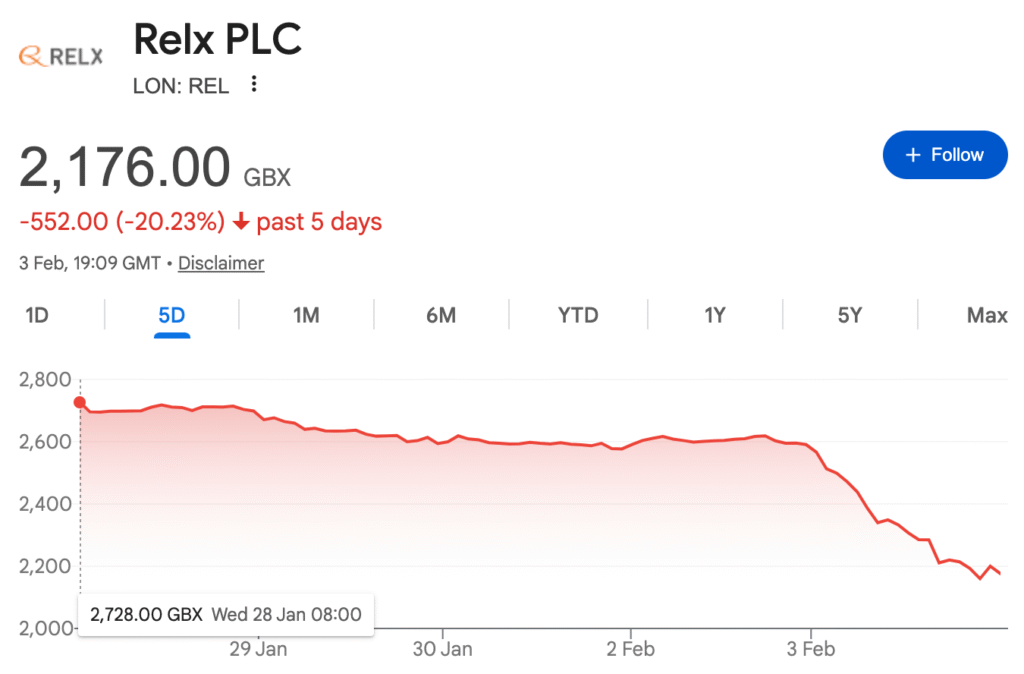
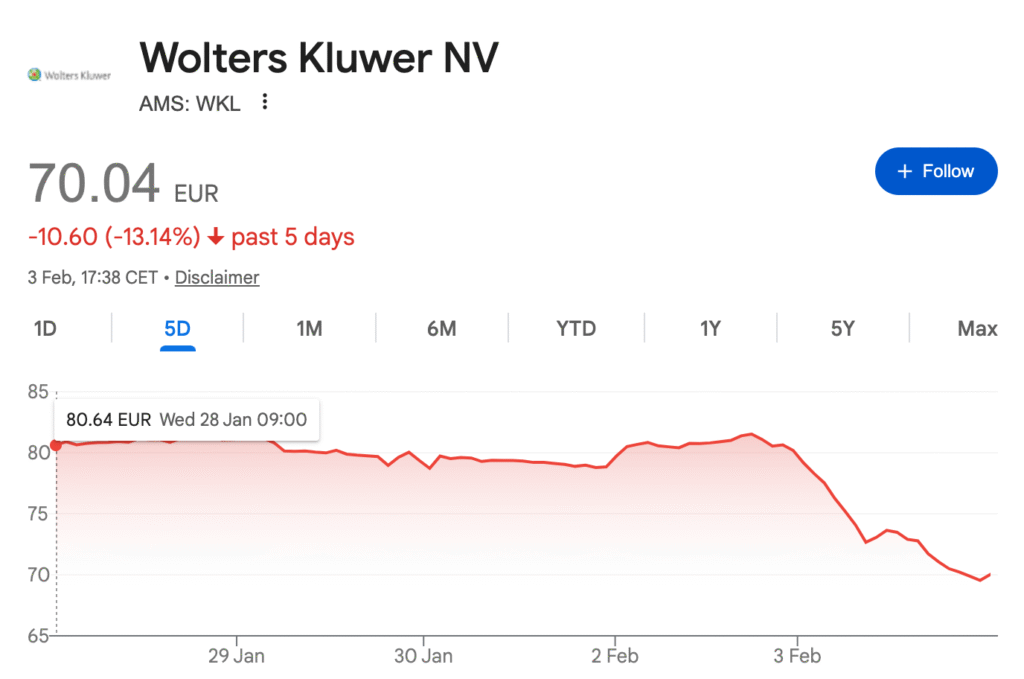
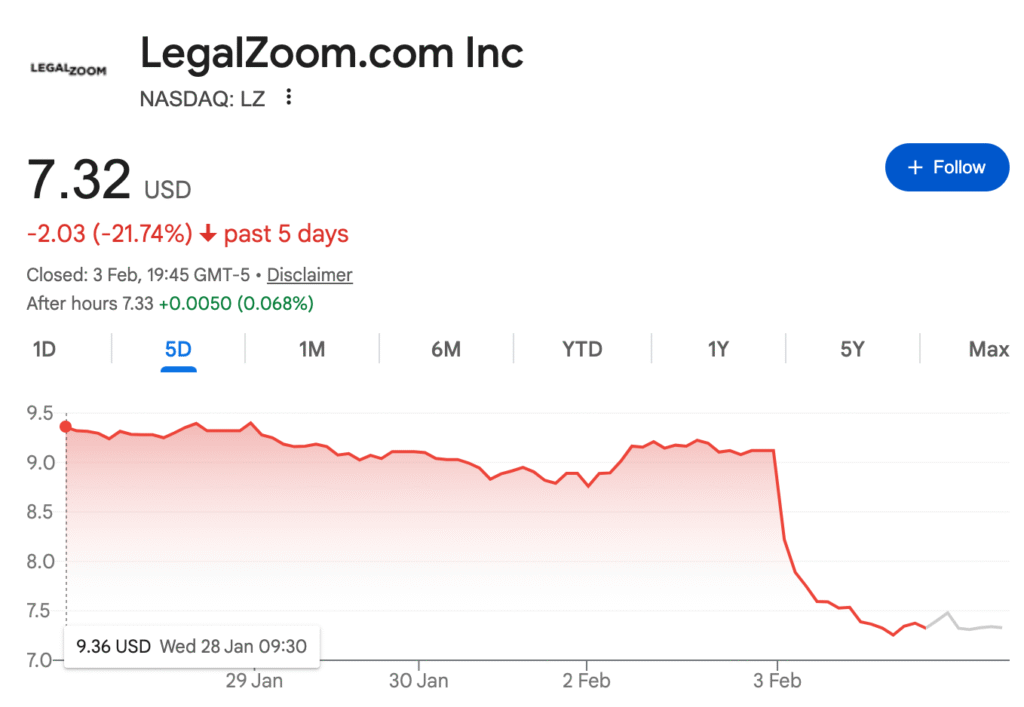
Even LegalZoom experienced a dip, and they are really very different to the above three companies. And that shows this is perhaps more of a sector sell-off than a careful strategy.
So, what’s happening and why is selling off TR, RELX and WK stocks such a strange move? (Note: AL has no shares in any of the companies mentioned.)
First, the plugins that Anthropic is offering are not super easy to use ‘out of the box’, and any law firm or legal team would likely need an enterprise licence to safely use them and some tech team help. So, that limits uptake.
Then comes the question of whether any firm would use them at scale, especially when they already have deals with a range of very sophisticated legal AI companies.
Next, and this is the key point really, TR, Lexis and WK are at heart legal data fortresses. In many ways they are the most secure of all legal tech companies because of the proprietary data – case law and contract data – that they hold, and have spent decades curating and making searchable. And they are now connecting that data to a range of AI skills. Those data collections cannot easily be copied by anyone else in the market, hence they have an incredible moat.
What the plugins do, e.g. mostly vanilla contract review, has very little in common with what a huge legal data library offers, even if there is some overlap when the data giants offer contract review as well.
Where the plugins do have an impact is where they are competing with relatively simple and commoditised legal tech tools – i.e. the ‘wrappers’ as they’ve been called. But, that’s not the above legal data giants, which are tying any of their additional AI skills back to their legal research or contract libraries.
So, Where Will The Claude Crash Have A Real Impact?
As noted, it’s on the basic end of legal tech where Anthropic may have the most impact, e.g. a legal team that perhaps already uses Claude or OpenAI models a bit, and perhaps uses a legal tech tool for contract review – but not a great one, and does not use a major platform with tons of additional capabilities. They look at the plugins and say: ‘You know what, let’s just get our tech team to set this up for us, and then we can drop this older, more basic contract review tool that we use.’
Companies in that bucket – which mostly are not listed on the stock market – could see a hit to their valuations, as well as a reticence from VCs to invest.
But…..if a tool is super-sophisticated, or provides a very broad range of connected skills, or is linked to very useful data that no-one else can control in the way they do, or all three at once, then why give up on all of that for a relatively basic plugin? All of the more complex tools are tapping LLMs already, but bring a lot more with them. Why jettison what they bring to the party?
Moreover, we don’t know yet if Anthropic is really going to push hard with legal and other enterprise verticals. Maybe they will stop where they are? If so, such tools will seem even more limited as time goes by.
Of course, there are law firms such as Freshfields, which has gone all in on a vibe-coding strategy and works with the Google suite to build whatever tools its needs, as and when it needs them. But they are almost the exception that proves the rule. Most law firms like the security of buying in trusted legal tech brands – with founders they can talk to about their complex legal needs.
Overall, most large law firms and legal teams just don’t have a huge driver to dump what they currently use.
Conclusion
Anthropic’s move into legal tech is massive, in that we have been waiting for years for Big Tech to make such a move and now it’s happened.
But, its impact will not be that of a sledgehammer. Rather, it will impact a range of tools in different ways, and mostly those that are not offering customers much beyond what general LLMs can offer already. Those weaker, more shallow offerings – AKA the ‘wrappers’ – are in trouble. Even if they don’t lose customers now, investors will believe they soon will.
The broad offerings that are very hard to replicate, the ones that really pioneer innovative approaches, and the data giants (or a combination of all three) – those are the ones that a handful of plugin skills can’t really impact that much in the real world.
But, then, as they say, the stock market is irrational.
Claude Crash Impact on Thomson Reuters + LexisNexis is Irrational