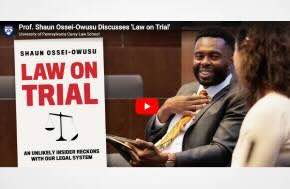
Professor Shaun Ossei-Owusu’s new book, Law on Trial, examines how legal institutions and practices shape—and at times reinforce—social inequality.
Shaun Ossei-Owusu LPS’08, Presidential Professor of Law, has released his first book, Law on Trial: An Unlikely Insider Reckons with Our Legal System (W. W. Norton and Company, 2026).
“One thing that I want readers to take away from this book is that the training of lawyers is not some kind of idiosyncratic professional school issue—it’s something that impacts all of us,” said Ossei-Owusu. “When you think about many of the pressing issues of the day,lawyers are often in the background. Part of what I want to emphasize isthat their role in shaping inequality is not inevitable.”
The book examines a central tension at the heart of the American legal system: while it aspires to fairness and equality, its structures and day-to-day practices often produce unequal outcomes. Drawing on more than a decade of research, teaching, and lived experience as a Bronx native, Ossei-Owusu offers a deeply informed perspective on how the system operates in practice.
Through his lens, he explores how routine legal practices and decision-making—whether intentional or not—can reinforce existing disparities. He also identifies points of intervention for those seeking to influence and improve the system.
“Law on Trial is an incisive, surprising, and deeply insightful account of how lawyers play a key role in sustaining inequality and injustice,” said Imani Perry, author of South to America: A Journey Below the Mason-Dixon to Understand the Soul of a Nation.
Divided into four sections, Ossei-Owusu takes readers on a “legal odyssey” through law school classrooms, government offices, Big Law conference rooms, and public interest practices, pulling back the curtain on legal education and the profession.
He begins by examining how lawyers are trained, showing how law schools—despite efforts to diversify—continue to reflect a relatively narrow demographic and professional pipeline. Within this environment, students absorb not only legal doctrine but also a set of norms and assumptions that shape how they understand power, decision-making, and justice.
Ossei-Owusu then traces how these dynamics play out across the profession. He explores the discretionary decisions of government attorneys, the role of corporate lawyers in shaping the rules that govern powerful institutions, and the work of public interest advocates seeking to challenge systemic inequities. Together, these perspectives offer a nuanced account of how legal actors, across sectors, both challenge and sustain the systems they operate within.
Law on Trial contributes to ongoing conversations about the role of legal institutions in American life, offering readers a deeper understanding of how the system operates—and how it might be reimagined.
An interdisciplinary legal scholar with expertise in legal history, criminal law and procedure, civil rights, and the legal profession, Ossei-Owusu has held fellowships and visiting professorships at Harvard, Princeton, Columbia, the University of Chicago, and the University of Southern California.
His work sits at the intersection of law, history, and sociology and focuses on how governments meet their legal obligations to provide protections and benefits to poor people and racial minorities. He also works on stratification in legal education and the legal profession. At Penn Carey Law, he teaches courses in the areas of criminal law, professional responsibility, antidiscrimination law, social welfare law, and the business of law.
He received his PhD from the Department of African American Studies at UC Berkeley and his JD from Berkeley Law.
https://www.law.upenn.edu/live/news/18504-new-book-explores-inner-workings-of-the-american-legal