January 21, 2026
The blurb says
Author Matthew T. Henshon is an attorney and chair-elect of the ABA Science and Technology Law Section. He is scheduled to speak this week at the 2026 AI Summit in Davos, Switzerland.
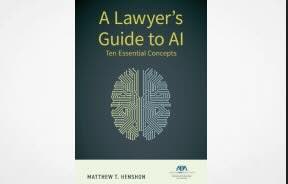
The book explores 10 essential concepts behind the development and use of AI. It gives readers space to sift through the complex technical and legal aspects of AI. It also examines the legal implications of AI’s rise in areas like copyright, privacy and algorithmic accountability.
The books’ intention is for readers to understand the historical, technical and legal dimensions of AI and why it is essential for lawyers, policymakers and anyone engaging with the technology. It guides the reader through such topics as What is AI?; Content Creation; Fair Use; Ethics and Law; AI That Moves (Drones and Self-Driving Cars); and The Dark Side to help them better navigate the realities of AI in everyday life.
“The roots of modern AI go back to at least the 1930s … And the current flavor of AI — called GenAI — has its roots in video games from the 1990s,” the author’s introduction notes. “The goal of this work is to explain how we got here, and where we are likely to go next. AI’s future is bright, but not without concerns.”
“A Lawyer’s Guide to AI: Ten Essential Concepts is available now on ShopABA.org.
Title: “A Lawyer’s Guide to AI: Ten Essential Concepts”
Publisher: ABA Book Publishing (Science and Technology Law Section, sponsor)
Pages: 270 pages
Product Code: 5450088
ISBN: 9-781-63905-684-2
Size: 6×9
Binding: Paperback
Price: $103.95 (member) $129.95 (non-member)
Orders: 800-285-2221 or ShopABA.org
About the Author: Henshon is partner at Henshon Klein, LLP, which delivers sophisticated expertise to its clients, usually relating to transactions and/or functioning as outside general counsel to emerging and mid-sized firms. HKLLP also represents individuals in a range of related business contexts, including risk mitigation, governance issues and estate planning. Clients include high net worth individuals, board members and executives.
Immediately prior to forming HKLLP (and its predecessors), Henshon served as “traveling” chief-of-staff to Senator Bill Bradley (D-NJ) during Senator Bradley’s campaign for the presidency.
He writes frequently on business, political and legal topics, and his work has appeared recently in the Boston Business Journal and on the New York Times op-ed page.
What others are saying about, “A Lawyer’s Guide to AI: Ten Essential Concepts”:
“Read this well-written book and you’ll understand how AI works and how it has moved us to where we are in the world today, confronted by fresh challenges to our economy and society. It is a new place, and it requires new laws to govern it and old values to guide it. Matt Henshon takes us on this journey with insight and optimism tempered by a thoughtful caution and an appealing humanity.” — Hon. Bill Bradley (former senator, D-NJ)
“This comprehensive volume recognizes the deep roots of current debates around AI unlike any other scholarship in the field today.” — Ted Ruger (former dean, University of Pennsylvania Carey Law School)
“With clear explanations and concise insights, Matt Henshon’s essential guide helps attorneys understand the important concepts around AI — from its history to where it is going.”— Hon. Richard Stengel (former Undersecretary of State, former editor of Time magazine)
Editor’s note: Review copies of this book are available by emailing Shirley Meyer at textbooks@americanbar.org. If you publish a review of this book, please share a link.