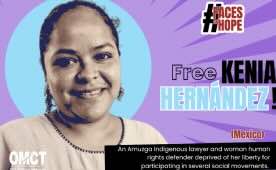
Kenia Inés Hernández Montalván, is an Amuzga indigenous lawyer and defender, of Afro-Mexican descent, mother and primary carer of two children, who has been unjustly deprived of her liberty for more than 5 years. After learning about the inequalities in which women in her community lived, she decided to study law to support them, dedicating herself to the defence of the territory in Guerrero, defending women victims of gender violence, and supporting the cause of political prisoners. Kenia co-founded the Movement for the Freedom of Political Prisoners of Guerrero (MOLPPEG), and founded the Libertarian Collective Zapata Vive, in which she worked with young people from the coast of Guerrero.
Due to her defence work, Kenia received several threats, some of them coming from armed groups from the Costa Chica region in Guerrero, forcing her to leave her territory in September 2019, as a beneficiary of the Protection Mechanism for Human Rights Defenders and Journalists until the moment of her deprivation of liberty.
Persecution and repeated arrests
On 7 June 2020, Kenia Hernández was arrested in the State of Mexico and charged with a crime of ‘robbery with violence’, which she did not commit, in the context of a public demonstration. She was subsequently released with a precautionary measure of periodic presentation.
On 18 October 2020, she was arrested again, without receiving a warrant or knowing the reasons for her arrest, for the alleged crime of ‘robbery with violence’ in the context of a public demonstration at the La Hortaliza tollbooth in the State of Mexico. Six days after the second arrest, an arrest warrant was executed for the alleged federal crime of “Attack on the General Roads of Communication” in Acapulco, Guerrero.
Over the following years, the Federal Roads and Bridges Police (CAPUFE), a decentralised entity of the Ministry of Communications and Transport of the Government of Mexico, charged her and, as a result, brought several other cases for the same offence, which led to her currently facing nine trials for an offence systematically used in Mexico to criminalise protest.
The criminal cases against her all share the same fact that the accusations, regardless of the crime charged, are related to acts of protest and public demonstration.
History of ill-treatment
During these more than four years, Kenia has been in four different prisons in the State of Mexico and in the Centro Federal Femenil de Reinserción Social 16 (CEFERESO Nº 16 in Morelos), the latter being a maximum security prison, where she carried out 2 hunger strikes requesting improvements of her detention conditions, since the prison imposes conditions contradictory to the United Nations Standard Minimum Rules for the Treatment of Prisoners (Nelson Mandela Rules), and where since 2022, 19 deaths in custody have been registered in this CEFERESO.
In January 2024 she was transferred to Ecatepec prison, State of Mexico, for reasons of family ties, after long insistence by her legal team and family. However, on 30 May 2024 she was physically assaulted by inmates of this prison, which is why she was transferred to protect her personal integrity to Nezahualcóyotl Sur prison, State of Mexico, where she is currently being held.
Arbitrary detention continues to be a widespread practice in Mexico, where human rights defenders are often subjected to reprisals and threats, including fabricated charges, for carrying out their work.