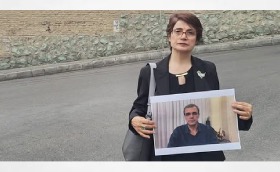
Reza Khandan was arrested in December 2024 for supporting women’s rights in Iran, and creating thousands of homemade buttons that said, “I Oppose the Mandatory Hijab.” He had previously been imprisoned for 111 days in 2018 for this so-called crime before being released on bail.
Reza’s wife, Nasrin Sotoudeh, spent over six years in Iranian prisons for her work as a human rights attorney and activist. Reza raised their daughter and son while maintaining his graphic design business, and defying government threats as he campaigned for Nasrin’s freedom. Now, Nasrin is home on a medical furlough for a heart condition that was exacerbated by COVID-19 and mistreatment in prison, and Reza is facing at least three more years in Tehran’s notorious Evin Prison.
I got to know these good people when I directed and produced Nasrin, a 2020 documentary about her life and work. She was in prison most of the time we were filming, and I saw Reza’s character— and love—repeatedly tested by a regime that punishes families as a way of inflicting additional pain on its detainees.
This interview started in April when I sent a series of questions to Reza. Slowly and with some complicated back and forth, he passed his answers to me.
Why have you put yourself at risk (in and out of prison) by criticizing your government—and is it dangerous for you to do this interview? I have a duty and the privilege to defend my rights and the rights of others. Without that, there is a dark future for us and our children. In a country like Iran, with this government, every protest and criticism carries a risk, but that’s a chance I’m willing to take.
You are a man, with all the privileges that brings in virtually every country. Why do you so strongly support women’s rights? No country can achieve democracy, and development with justice and human dignity, without guaranteeing equal rights for women and men. A society that ignores the rights of half of its population will never achieve real greatness.
Describe your December 2024 arrest. That morning, I’d gone to the store so I could do some work at the house. On my way back, I noticed several people standing by the entrance talking to the building manager. As soon as I got out of the car, they came towards me, pointed at my license plate, and said they were investigating a crime that had been committed with my car.
It quickly became clear that all of their words were lies, and their real intent was to arrest me for my judicial case. After a minute or so, Nasrin joined us. She asked if she could get our son Nima from upstairs so he and I could have a moment together before they took me away. They said yes, but when she left to get him, they forced me into their car and drove off. I never got a chance to say goodbye to my son.
Meet the Jailed Husband of Iran’s Most Prominent Women’s Rights Defender