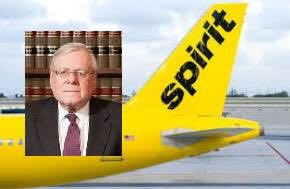
A lead editorial in the Wall Street Journal on May 4, “Spirit Airlines and the Antitrust Left,” was a reckless and libelous attack against U.S. District Court Judge William G. Young for his decision in United States, et al. v. JetBlue Airways Corp. and Spirit Airlines, Inc. That the WSJ sullied its own reputation by publishing the editorial is of little concern. Its editors’ ignorance of the law, the case, and the Clayton Act are inexcusable given the mean-spirited rant against a distinguished judge.
The editorial stated: “Federal Judge William Young admitted Spirit’s financial troubles. He also agreed that ‘an expansion of all aspects of JetBlue’s business — including network, fleet and loyalty program — would allow for more vigorous competition with the Big Four, which carry most passengers in the country.’ He still ruled the merger an antitrust violation because it would eliminate one low-fare option on some routes.”
It then went on to say: “Well, congratulations Judge Young. With Spirit’s demise, that low-fare option is gone. The big boys are likely to snap up Spirit’s planes, airport gates and other assets, and there will be less competition than if the merger had been allowed. JetBlue is also struggling these days. Judge Young owes those Spirit employees and the traveling public an apology, and so does [the Department of Justice’s Jonathan] Kanter.”
Young’s decision was based on careful findings of fact and application of the law. It is noteworthy that the Biden DOJ on behalf of the United States was not the sole plaintiff. The true culprits in the case were all the plaintiffs, namely: the District of Columbia, the commonwealth of Massachusetts, and the states of California, Maryland, New Jersey, New York and North Carolina, all of which sought an injunction to prevent the merger of the two airlines.
In cases under the Clayton Act, the issue is the likely effect on competition and consumers based on the evidence presented by the government and by defendant companies. The trial lasted over four weeks.
In Young’s decision granting the requested injunction sought by the Biden DOJ and its collaborators, who professed concern — albeit short-sighted and ideological — for consumers, the judge painstakingly reviewed the trial evidence and applicable law. The parties requested findings of fact, and the issues were thoroughly and professionally briefed, which the judge noted in his decision.
In a somewhat rueful, humorous acknowledgement of the unpredictability of the future, Young began the 110-page decision with: “[I]t’s ‘tough to make predictions, especially about the future.’… Perhaps apocryphal, this statement has been attributed to New York Yankees catcher Yogi Berra, the physicist Niels Bohr, and others. The statement, however, also rings true when attempting to predict the future of the airline industry; as a fast-moving enterprise, with portable assets and dynamic growth cycles, the industry’s potential responses to changes in economic conditions are almost impossible to predict. Yet, federal antitrust law aims to preserve the free functioning of markets and participation of diverse competitors by attempting to do just that: predict the future.”
The DOJ met its factual burden by presenting evidence of the effect the merger would especially have on consumers who relied on Spirit for less lucrative routes that would no longer have a low-cost airline competitor, and others that would at least for a substantial period of time be abandoned and/or replaced by major airlines without the constraints of a low-cost airline competitor.
The defendants presented evidence and arguments rebutting each of the required findings that the plaintiffs needed in order to be entitled to an injunction, but in asserting the defense related to the “failing company” doctrine that, if successful, would have overcome the plaintiffs’ claims, the defendants held back a critical piece of evidence. This is important because the obvious negative impact on competition and on consumers is, as we have now seen, disastrous if the financially weak company fails. This defense takes a “lesser of two evils approach.” The defendant airlines argued that because Spirit was struggling financially, its “market share [is reduced] to a level that would undermine the Government’s prima facie case.”
Quoting an 11th U.S. Circuit Court of Appeals case, Young called that defense a “hail-Mary pass.” The defense missed the mark. The requirement that an acquired firm’s weakness “cannot be resolved by any competitive means means that the weakness cannot merely involve poor financial performance. It must involve a firm no longer able to access resources that are necessary to compete.”
Read full article: