
25 October 2016
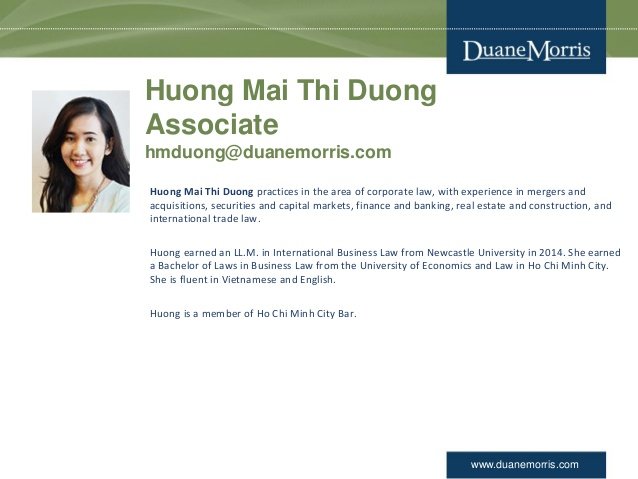
Vietnam has recently been approved to participate in the Qualified Lawyers Transfer Scheme (QLTS) of England and Wales, thanks in part to a lot of hard work by Duane Morris associate Huong Mai Thi Duong in Ho Chi Minh City.
This means that nowVietnamese lawyers now have a fast-track way to become qualified as solicitors in England and Wales, joining a list of around 100 other eligible jurisdictions globally.
Without QLTS, it would normally take at least three years to complete the qualifications, including one year of legal practice course study and a two year training contract with an English law firm.
While qualified lawyers are still required to pass the QLTS examination in England, there is no compulsory academic study required before taking the examination. The QLTS process takes anywhere from six months to one year, saving Vietnamese lawyers a good deal of time and money.
Ms Duong proposed the initiative to the Vietnam Business Lawyers Club—a unit of the Vietnam Bar Federation, then worked with the Federation to get its approval and worked with the Solicitors Regulation Authority of England and Wales (SRA) to formalize the arrangements.
Vietnam was added to the list on October 4 2016.
Ms Duong recognized the benefits of QLTS while studying for her LLM at Newcastle University.
Legal Eye loves a lawyer who can think on their feet so we thought a few questions to her would be in hand
What was the process to get the proposal through the Vietnam Business Lawyers Club—& the Vietnam Bar Federation?
Neither the VBLC nor the Vietnam Bar Federation was aware of the QLTS before. I heard about the QLTS, which offers the opportunity for the qualified lawyers of other countries to be qualified as English solicitor since I studied my LLM at Newcastle University during 2013-2014.
When I got back to Vietnam in Jan 2015, I researched more about QLTS and found out that Vietnam was not listed as one of the recognized jurisdictions to be entitled to the benefits of the QLTS.
I contacted the SRA by myself to ask for the procedure to register Vietnam into the list. The representatives of SRA were very helpful and advised that it must be completed and by a representative of home Bar or Law Society, for example, a member at supervisory status. Which means, I, individually, could not complete the survey and submit the survey.
So it took be a while to discuss with other lawyers of other firms in Vietnam, who are not only qualified in Vietnam, but also in other countries, such as US, France, etc., to collect their views if it is worth to be qualified in other countries. At the time there were controversial opinions about this matter, besides those supported the idea, there was opinion that when we practice in Vietnam, it is enough and sufficient to get the qualification in Vietnam. So I needed to talk to the right person of the Vietnam Bar Federation about the QLTS to get its approval to do this.
How long did this take?
I first shared the idea of QLTS with the others in December 2015, but it took me a while to identify and talk to the right person, who has the authority decide and approve me to work with the SRA on this project.
The establishment of VBLC (a unit of Vietnam Bar Federation) in December 2015 is one of the factors contributed to the approval of the Vietnam Bar Federation to proceed with the registration of Vietnam to the list of Recognised Jurisdictions.
After registering as a member of VBLC, I met the Chairman of VBLC – Mr. Nguyen Tuan Phong, and discussed with him about QLTS and its benefits. He opined that it is a good idea to open the door of opportunity to other lawyers, and suggested me to submit an official letter to VBLC and Vietnam Bar Federation. I then received the feedback from the Vietnam Bar Federation approving me to proceed with SRA to register Vietnam to the list of Recognised Jurisdictions. It took me around 2 weeks to work with the VBLC to collect necessary data and complete the survey of the SRA. Finally, we got the approval from the SRA registering Vietnam as one of the Recognised Jurisdictions on 4 October 2016, after around 30 days since submission.
Did you approach Qualified Lawyers Transfer Scheme (QLTS) personally or on behalf of Vietnam Business Lawyers Club—& the Vietnam Bar Federation?
I approached the SRA to ask about the QLTS last year personally regarding the procedure to register Vietnam into the list of Recognised Jurisdictions. SRA was very responsive and sent to me a form of survey to fill in. Then, after successfully persuading the VBLC and Vietnam Bar Federation, I was assigned to contact SRA on their behalf to get Vietnam into the list of Recognised Jurisdictions
How many times a year will people sit for the examination
For clarification, in order for a qualified lawyer in another jurisdiction (the “Applicant”) to be qualified as solicitor of England and Wales, there are basically 4 conditions must be met:
– From a recognised jurisdiction as published by the SRA
http://www.sra.org.uk/solicitors/qlts/recognised-jurisdictions.page
– Having passed 2 stages of QLTS assessment:
The Multiple Choice Test (MCT): the MCT is a 6 hour 180 question test which assesses Part A of the Day One Outcomes, including knowledge of:
· the jurisdiction, authority and procedures of the legal institutions and professions that initiate, develop, interpret and apply the law of England and Wales and the European Union;
· applicable constitutional law and judicial review processes;
· the rules of professional conduct, including the SRA Accounts Rules;
· the regulatory and fiscal frameworks within which business, legal and financial services transactions are conducted;
· understanding of Contract law; torts; criminal law; property law; equitable rights and obligations; human rights; the laws applicable to business structures and the concept of legal personality.
The Objective Structured Clinical Examination (OSCE)- this assesses part C, D and F of the Day One Outcomes, including:
· Part B: Intellectual, analytical and problem-solving skills;
· Part C: Transactional and dispute resolution skills;
· Part D: Legal, professional and client relationship knowledge and skills;
· Part E: Personal development and work management skills.
This means that the skills of interviewing, advocacy/oral presentations, legal research, legal drafting and legal writing in business, civil and criminal litigation, property and probate.
Note: The assessments are only available at Kaplan QLTS which is the only SRA approved assessment provider for QLTS assessments
– English requirement: although it is not required to provide separate evidence of English language skills however the applicant should ensure that the standard of written, spoken, reading and listening English is appropriate for the assessment.
– Meet the requirements as to character and suitability. This will include the provision of a certificate of good standing from the home bar or professional/regulatory body.
Upon the satisfaction of the above requirements, the Applicant can apply to the SRA for admission to the Roll of Solicitors of England and Wales.
What uptake are you hoping for from Vietnamese Lawyers
Although Vietnam is a civil law country, but step by step, it tends to be a combination between civil law and common law, especially in dispute settlement. The dual qualification will help them to be well prepared in advance. In addition, dual qualification means a qualified lawyer not only can advise Vietnamese law, but also English law. This will be an advantage for those with dual qualification of English solicitor and Vietnamese qualified lawyer when more and more cross-border transactions are governed by English law in Vietnam. Furthermore, the dual qualification will also help Vietnamese qualified lawyers to be capable to involve in the legal industry of other jurisdictions in Asia, such as Hong Kong, Singapore and Myanmar, as their laws are based on English law. Not only the dual qualification will help the Vietnamese qualified lawyers to be more reputable, but also the firm can be more marketable.
Will the UK Solicitors Regulation Authority of England and Wales (SRA) be working directly with a range of legal groups, organizations and associations in Vietnam
Each qualified lawyers in Vietnam, who is interested in the QLTS and wishes to be qualified as an English solicitor, he/she will need to proceed personally. The VBLC will support to issue the certificate of good standing for him/her – as a requirement from the SRA in order to be officially qualified.
Is it compulsory to take any course to prepare for the test?
There is no compulsory study prior to the QLTS tests, it is up to the applicant to take training course prior to assessments or not. However, it is still advisable to take training prior to the tests. Depending on each Applicant to arrange their time for study, if necessary, the total time to be qualified as English solicitor can be from 6 months to one year. Meanwhile, usually, for English citizens, it can take them at least 3 years to be qualified as solicitors, including 1 year of study of Legal Practice Course, and 2 years of training contracts at a law firm. That is to say, the QLTS is a fast-track route for foreign lawyers to be qualified as solicitors of England and Wales.
Does this mean that these Vietnamese lawyers will be able to practice in British courts? Or does it convey some other value? In other words, what can approved solicitors do now that they couldn’t do before? How will it benefit the firm, and more important, how will it benefit clients?
No, once being qualified as solicitor of England and Wales under the QLTS, the applicant – who is also Vietnamese qualified lawyer can perform the work outside courts as an English solicitor, such as providing clients with legal advice, undertaking negotiation and draft legal documents.