A first-of-its-kind random-sample survey of federal judges has found that more than 60% have used generative artificial intelligence tools in their judicial work, though fewer than one in four use these tools on a daily or weekly basis.
The study, conducted by researchers at Northwestern University in collaboration with the New York City Bar Association, provides an empirical snapshot of how AI is being integrated — and not integrated — into federal court chambers.
The research, “Artificial Intelligence in Federal Courts: A Random-Sample Survey of Judges,” forthcoming in Volume 27 of The Sedona Conference Journal, surveyed 502 randomly selected bankruptcy, magistrate, district court and court of appeals judges in late 2025. Of those, 112 responded, for a 22.3% response rate.
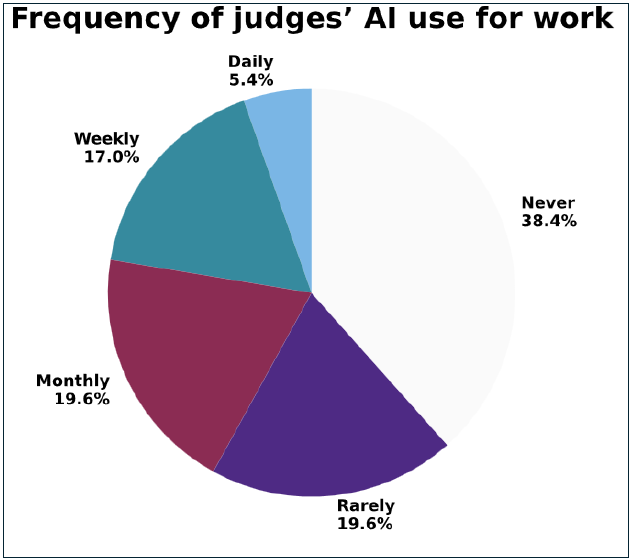
The survey found that 61.6% of responding judges use at least one AI tool in their judicial work. Of those, however, few use it frequently. Only 5.4% reported daily use, while 17% use AI tools weekly. Another 19.6% use AI monthly, and the same percentage use it rarely. The remaining 38.4% reported never using any of the listed AI tools in their work.
“Although a majority of responding judges at least occasionally use AI tools in their judicial work, relatively few report using AI on a daily or weekly basis,” the report states. “This pattern suggests that AI is present in federal judicial chambers but not yet a routine, embedded part of most judges’ decision-making processes.”
A Preference for Legal AI Tools
The survey found a clear preference among judges for legal-specific AI tools integrated into established research platforms rather than general-purpose AI systems such as ChatGPT.
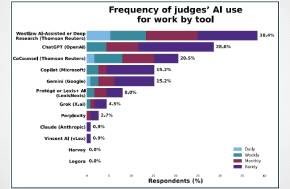
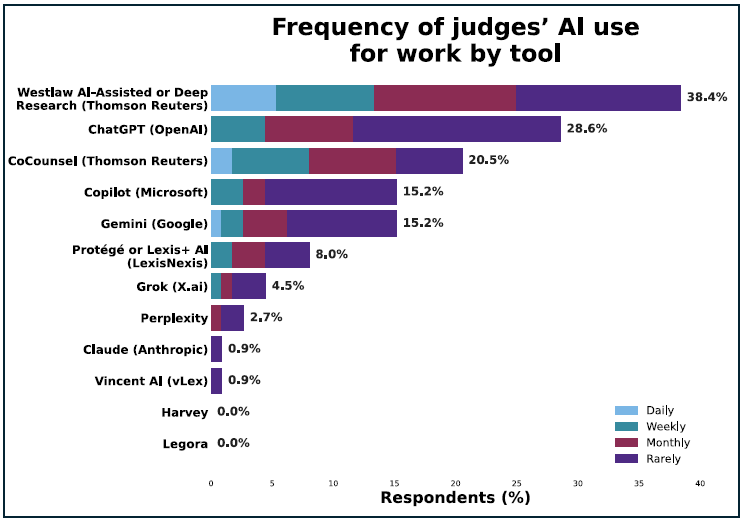
That said, while Westlaw AI-Assisted Research or Deep Research was the most commonly used tool, with 38.4% of judges reporting some level of use, ChatGPT came second at 28.6%.
However, the frequency of use differs between legal-specific and general tools. For legal-specific AI tools, 5.4% of judges reported daily use and 9.8% reported weekly use. For general-purpose AI tools, only 0.9% reported daily use and 9.8% reported weekly use.
“This pattern indicates that vendor familiarity and perceived reliability may strongly shape which AI tools judges are willing to deploy in chambers,” the report notes.
Other AI tools showed minimal adoption. Anthropic’s Claude was used by only 0.9% of judges, all at a frequency of “rarely.” Harvey and Legora showed 0% usage across all responding judges. Vincent AI (vLex) similarly showed only 0.9% rare usage.
Legal Research Dominates Usage
When asked about specific applications, judges overwhelmingly pointed to legal research as their primary AI use case. Thirty percent of judges reported using AI to conduct legal research, making it the most common application by a significant margin.
Document review came in second at 15.5%, followed by drafting documents not filed in cases (7.3%), summarizing text or audio (7.3%), and preparing case timelines or chronologies (5.5%).
Notably, judges reported minimal use of AI for drafting or editing documents that are filed in cases. Only 1.8% reported using AI to draft filed documents such as orders, opinions or judgments, and 2.7% reported using AI to edit such documents.
This contrasts with higher rates for non-filed documents: 7.3% use AI to draft letters, emails or articles, and 4.5% use AI to edit such materials.
The survey also found that 1.8% of judges reported using AI to “make decisions,” while 4.5% reported using AI to “inform decisions.”
Staff Show Similar Patterns
Judges reported slightly higher AI usage compared to others in their chambers. While 50.9% of judges said they do not use AI in their work, a somewhat lower 45% reported that others in their chambers do not use AI.
Legal research remained the top use case for chambers staff at 39.8%, followed by document review at 16.7%. The patterns largely mirrored judges’ own usage, though judges reported that staff use AI for legal research approximately 10 percentage points more frequently than judges themselves do.
Several judges indicated uncertainty about how their staff actually use AI. One responded simply, “I am not certain whether they use any type of AI.” Another recounted an incident where “my law clerk wrote a memo for me, and then after she finished, out of curiosity, she asked AI to write a memo on the same question. Of the 11 cases AI cited in its version, 10 of them were fake.”
Training Gap Identified
The survey revealed what the researchers describe as “unmet demand” for AI training in the judiciary. Nearly half of judges (45.5%) reported that AI training had not been provided by court administration, and an additional 15.7% were unsure whether training had been offered.
Among the 38.9% who recalled training being offered, a significant majority (73.8%) attended. This suggests that when training is provided and visible, judges are receptive to it.
Training availability and attendance varied by judge type. Magistrate judges reported the highest rate of attending training at 40%, followed by bankruptcy judges at 36.7%. District court judges reported attending at a lower rate of 16.7%.
Chambers Policies: A Mixed Picture
The survey found no dominant approach to AI governance within chambers. Approximately one-third of judges either permit and encourage (7.4%) or permit (25.9%) AI use by those working in their chambers. Another third either formally prohibit (20.4%) or discourage but do not formally prohibit (17.6%) AI use.
One in four judges (24.1%) reported having no official policy on AI use. If those who merely discourage AI without formal prohibition are included, 41.7% of judges lack an official AI policy.
Several judges who selected “permitted” or “permitted and encouraged” described significant limitations. One wrote: “I have a firm policy, though, against AI generating content of orders, opinions, or communications.”
Another specified that AI is “permitted and encouraged, but within very narrow guardrails. Only as part of Westlaw or Lexis research tools, and only to summarize voluminous materials.”
Similarly, some judges who selected “formally prohibited” carved out exceptions. One noted: “My clerks can use AI for legal research (Westlaw) but not for other functions.”
Another wrote: “It’s fine to use for something like a poem celebrating a birthday or anniversary. But I do not permit it for case-related work.”
Personal Use Correlates with Professional
The survey found a statistically significant correlation between judges’ personal and professional AI use. The researchers used a statistical analysis tool, the chi-square test, and found what they described as “strong statistical evidence” of association. Another statistical analysis method, the Cramér’s V test, found a moderate strength of association between their personal and professional use.
Overall, 38% of judges reported using AI daily or weekly outside of work. When asked about personal AI uses, judges described a wide range of applications: trip planning, restaurant recommendations, general knowledge searches, drafting personal correspondence and household questions.
One judge who uses AI daily outside work wrote: “I use them every day to get answers to questions as they pop up throughout the day. I do not ever use AI to work on my cases.”
One in five judges (20.4%) reported never using AI in either their personal lives or their work.
A Split Between Optimism and Concern
When asked about their general outlook on AI’s potential for the judiciary, judges were nearly evenly divided. Slightly more than 43% expressed optimism (13% very optimistic, 30.6% somewhat optimistic), while approximately 42% expressed concern (13.9% very concerned, 27.8% somewhat concerned). Another 14.8% were neutral.
Read full report