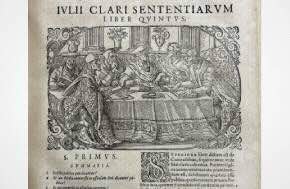
In the last few months, I had a chance to write two posts on the subject of criminal law and criminal law books in 16th-century Europe. I mentioned in this post on Hippolytus de Marsiliis (the first European professor of criminal law) that there were two tiers of legal personnel operating the courts in that era, one populated by learned lawyers, the other by laymen. But in addition to there being two tiers of personnel, there was also often at least two tiers of law, that is, the learned law – Roman law and canon law – on the one hand, and the statutes and customs of local jurisdictions on the other. I described that situation further in this post on Lodovico Carerio, whose 1546 book on criminal law blended the learned law with the statutes of the Kingdom of Naples. The work of applying the learned law together with local statutes and customs was a standard part of the work of a judge at that time, and there was a market for expert guidance on how best to do it. Another important author from that time who was busy crafting a synthesis of rules from practice, local law, and the opinions of learned authorities was Giulio Claro (1525-1575). This post is about him.
Giulio Claro (1525-1575) spent his professional life mostly in roles of public administration, primarily in the city of Milan and in the court of Phillip II of Spain. Among those roles, he served in an advisory capacity in the senatorial ordo of Milan; between 1560 and 1561, he was the praetor – or chief administrator and judicial authority in the civil and criminal courts – of the Lombard city of Cremona. (Moeller, p. 71.) In 1563, he was president of the Extraordinary Magistracy in Milan, which was the advisory council responsible to the Dutchy of Milan’s Grand Chancellor; it had responsibility over property and financial matters for the state. (Moeller, p. 78.) In 1565, King Philip II raised Claro to the position of regent of the Consiglio Supremo d’Italia – the Supreme Council of Italy – in Madrid. In that body, he held authority over the kingdoms of Sicily, Naples, and Milan in matters of judicial oversight and appeals, but also in royal appointments, patronage, and policy. (Moeller, p. 168.)
All of these positions required Claro to serve in a judicial capacity, a role in which he excelled. He had trained in law both at the University of Bologna, and (primarily) at the University of Pavia where in 1550 he achieved a doctorate in utroque iure (in both Roman and canon law). He counted himself a student of the famous humanist Andrea Alciato (1492-1550), whose death he remarked was one of the major turning points of his life. He was also under the influence of professors Niccolo Bellone of Casale Monferrato and Giacomo Mandelli of Alba (1510-1555). (Massetto, 2013, pp. 551-555; Moeller, pp. 20-22.) His written works stand somehow between these two poles; like Bellone and Mandelli, he accepted the necessity of working within the late medieval approach to the ius commune, which was standard in the Italian legal academy of his time. On the other hand, he took a somewhat flexible approach to the learned law, one that, like Alciato’s humanism, made room for a distinction between ancient law and current practice. (Moeller, pp. 103-107.)
Claro began most of his important book projects between 1550 and 1555, the years directly after his studies, a time which he spent to a large degree in his hometown of Alessandria. Inspired by humanism, he set about living a life of letters. He drafted a history of the world from the reign of Charlemagne to the current day. He wrote a discourse on natural philosophy and medicine. He also wrote a treatise on dueling. These and other writings remained unpublished. He was also engaged in research on the law. During that time, he planned and began composing an exceedingly ambitious work: a sort of encyclopedic work in which he wanted to present the consensus of legal opinion, or the “sententiae receptae,” on all the important topics of the law in his time. (Moeller, pp. 33-43.)