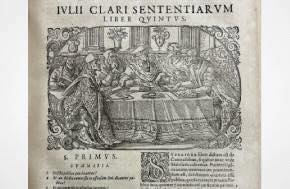
In the last few months, I had a chance to write two posts on the subject of criminal law and criminal law books in 16th-century Europe. I mentioned in this post on Hippolytus de Marsiliis (the first European professor of criminal law) that there were two tiers of legal personnel operating the courts in that era, one populated by learned lawyers, the other by laymen. But in addition to there being two tiers of personnel, there was also often at least two tiers of law, that is, the learned law – Roman law and canon law – on the one hand, and the statutes and customs of local jurisdictions on the other. I described that situation further in this post on Lodovico Carerio, whose 1546 book on criminal law blended the learned law with the statutes of the Kingdom of Naples. The work of applying the learned law together with local statutes and customs was a standard part of the work of a judge at that time, and there was a market for expert guidance on how best to do it. Another important author from that time who was busy crafting a synthesis of rules from practice, local law, and the opinions of learned authorities was Giulio Claro (1525-1575). This post is about him.
Read the post