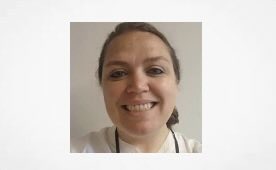
Here’s the AALL interview with Kristin
Kristin Neri is a Law Librarian for the New York State Supreme Court in the Fifth Judicial District. She brings experience from public, academic, and government libraries, where she works to connect the public with meaningful access to legal information. As part of that commitment, Kristin staffs the NYS Unified Court System’s “Ask a Law Librarian” live chat and 800 line, answering questions from across the state to support equal access to justice. She currently serves as Vice President of the Association of Law Libraries of Upstate New York (ALLUNY), where she also chairs the Continuing Education Committee and sits on the Government Relations/Advocacy Committee.
She serves on the Executive Board of AALL’s Social Responsibilities Special Interest Section (SR-SIS) as Secretary/Treasurer and participates in multiple SIS groups focused on government law libraries, legal history, public information, neurodiversity, disability, and LGBTQ+ issues.
She is also a fellow of the 2024 AALL Leadership Academy and a member of the Leadership Mentor Program. Kristin co-chairs the Community Outreach Subcommittee and serves on the DEI Subcommittee of the 5th Judicial District’s Access to Justice Commission.
Within the NYS Unified Court System, she participates in statewide workgroups focused on improving public legal access through helplines and public access terminals, and she is a founding member of the Langston C. McKinney (Syracuse’s first Black American Syracuse City Court Judge) Courtroom Dedication Committee and the 5th District Officer of the NYS Unified Court System’s Pride Alliance.
As part of her work with the Pride Alliance, Kristin coordinated a virtual event featuring a panel of LGBTQ+ professionals in the New York State Court System, including a Court of Claims judge, a City Court judge, and a court clerk, who shared their stories and experiences working in the judiciary.
The event was designed to foster visibility, inclusion, and community for LGBTQ+ court employees and allies.
What does diversity mean to you?
To me, diversity is not just about representation, it’s about being mindful of how power operates, creating space for new voices and perspectives, and reflecting on who may still be left out, even as progress is made. It also means recognizing that meaningful change takes more than statements or symbolic gestures. DEI should be ongoing, intentional work that is supported by both structural commitment and individual effort How has diversity impacted you thus far in your law librarian career? Diversity has shaped every step of my career. I’ve worked in academic, public (nonprofit), and now government libraries, and in each space, I’ve seen how DEI work can be sidelined or reduced to a talking point. I’ve learned that change does not come from asking politely, it comes from organizing, connecting, and doing the work, even when institutional support is lacking. That is why I have taken on roles that allow me to push for change in practical, community-centered ways. I focus much of my work on improving public access to justice and building inclusive professional spaces, from local initiatives like the Access to Justice Commission in New York’s Fifth Judicial District to national service through AALL’s Social Responsibilities SIS. I am also working on obtaining nonprofit status for an association that supports LGBTQ+ court employees through community-building, advocacy, and education. All of this is rooted in the belief that inclusion only matters if it’s actionable.
What role has networking played in your DEI work?
None of the work I do would be possible without networking. From finding presenters for Annual Meetings to seeking advice on how name changes are handled in other states, I constantly rely on the knowledge, generosity, and experience of colleagues around the country, and beyond! One recent example is a collaboration between the SR-SIS Disability Issues group and the Neurodiversity Caucus, where we are developing a free, open-source, and highly customizable planner designed especially for law librarians, or really anyone, who depends on structure and organization but finds traditional planning tools inaccessible or rigid. This resource emerged entirely from peer conversations and shared lived experience. It’s a grassroots solution to a widespread need, and exactly the kind of project that can only grow through authentic community connections. That said, as someone with an adult diagnosed ADHD and self-diagnosed social anxiety, networking has not always come easily to me. It can be exhausting and intimidating. But I have learned that building community does not require being the most outgoing person in the room. It requires intention, curiosity, and showing up even when it’s hard. The relationships I have built through both local and national networks are what make this work sustainable and possible.