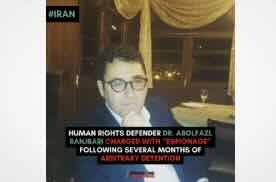
9 October 2025 marked the fifth month of arbitrary detention of human rights defender Dr. Abolfazl Ranjbari without trial. In May 2025, the human rights defender was initially charged with “propaganda against the state” and in September 2025, Branch 15 of the Tabriz Revolutionary Court charged the human rights defender with “espionage for the Republic of Azerbaijan”. Dr. Abolfazl Ranjbari was reportedly charged in connection with his participation in an academic conference in Baku seven years ago during which he presented an analysis of the Iranian Judiciary System.
Dr. Abolfazl Ranjbari is a human rights defender, lawyer and university professor in Tabriz, known for representing political and marginalised ethnic activists in Eastern Azerbaijan Province in Iran. In September 2022, following the nationwide protests sparked by the killing of Mahsa Amini, Dr. Abolfazl Ranjbari was among 70 Iranian jurists who signed an open letter calling for the abolition of the “morality police” and the creation of an independent fact-finding commission to investigate human rights violations. During this period, he actively followed up on the cases of detained lawyers and protesters.
In September 2025, Branch 15 of the Tabriz Revolutionary Court charged Dr. Abolfazl Ranjbari with “espionage for the Republic of Azerbaijan” from Tabriz Central Prison via a remote video hearing. This charge was reportedly brought against the human rights defender in connection with his participation in an academic conference in Baku seven years ago during which he presented an analysis of the Iranian Judiciary System.
On 14 May 2025, Dr. Abolfazl Ranjbari was arrested by agents of the Iranian Ministry of Intelligence on charges of “propaganda against the state” and has since been arbitrarily detained in Tabriz Central Prison. From the outset of his detention, the human rights defender was held in solitary confinement for over three months and remains under harsh conditions in the prison’s quarantine ward, denied contact with his lawyer and family and access to essential medication. Although the investigation in his case has been completed, Iranian authorities have repeatedly extended his temporary detention order. Efforts to secure his release on bail were also reportedly blocked following pressure from security agencies in the Prosecutor’s office.
On 23 June 2025, the Iranian Parliament voted to intensify the punishment for charges related to “espionage” with nine amendments to the original text from May 2013. According to Amendment 1, any form of espionage for Israel or other states considered hostile is punishable by death. Moreover, Amendment 4 of the new espionage law stipulates that any propaganda activities that are considered hostile or undermining Iran’s national security can be punished with up to 15 years in prison, and, if it falls under the first amendment of the espionage law, with the death penalty.