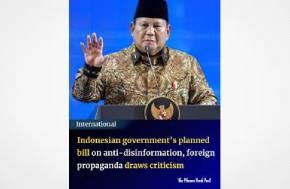
In its bid to clamp down on fake news, President Prabowo’s administration is arming itself with some concerning powers. writes the diplomat
Here’s a google AI roundup
In early 2026, the Indonesian government under President Prabowo Subianto introduced plans for a Bill on Countering Disinformation and Foreign Propaganda. The proposed legislation aims to protect national interests from what the administration describes as cross-border “information warfare” that could destabilize the country’s political and economic landscape.
 The Diplomat – Asia-Pacific +3
The Diplomat – Asia-Pacific +3Key Objectives and Government Stance
- National Resilience: Officials, including Coordinating Minister Yusril Ihza Mahendra, argue the bill is an instrument to strengthen national resilience against coordinated information attacks and “foreign propaganda” that misrepresents Indonesian interests.
- Economic Protection: The bill specifically targets narratives that could harm Indonesian products and economic competitiveness, citing instances where domestic products were portrayed negatively abroad.
- Targeted Entities: Unlike existing laws that target individuals, this bill is framed to hold digital platforms and organized “influencer” actors accountable for the content they distribute.
- Current Status: As of early 2026, the bill remains in the study and conceptual stage. No official final draft has been released, though academic manuscripts have circulated.
The Diplomat – Asia-Pacific +5
Critical Perspectives and Concerns
The initiative has drawn significant pushback from civil society and rights organizations:
- Freedom of Expression: Groups like the Indonesian Legal Aid Foundation (YLBHI) and Amnesty International Indonesia warn that the bill could be used to silence legitimate criticism, labeling it as “foreign propaganda”.
- Broad Definitions: Critics fear that vague definitions of “disinformation” and “propaganda” will grant the government broad powers to act as the ultimate arbiter of truth.
- Democratic Backsliding: Analysts from The Jakarta Post suggest the bill reflects a trend of “security-oriented regulation” that threatens civic space and expands digital repression.
- Legal Overlap: There are concerns that the bill overlaps with the existing Electronic Information and Transactions (ITE) Law, which is already frequently used to criminalize online speech.