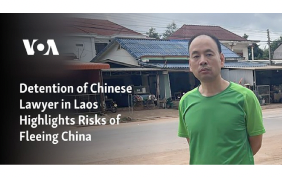
The arrest of Chinese human rights lawyer Lu Siwei in Laos late last month highlights the risks Chinese dissidents face when they flee China through Southeast Asia.
Despite his holding valid visas for Laos and the United States and a valid Chinese passport, Laotian police arrested Lu while he tried to board a train for Thailand on July 28. He was planning to board a U.S.-bound flight in Bangkok to reunite with his wife and daughter.
Analysts say the incident reflects worsening human rights conditions in China and Beijing’s long-arm jurisdiction in Southeast Asia, which has long been a common yet risky transit point for Chinese dissidents attempting to flee repression in their homeland.
My latest: The arrest of Chinese human rights lawyer Lu Siwei in Laos late last month highlights the risks Chinese dissidents face when they flee #China through Southeast Asia.
Feat: @BobFu4China, @Peterinexile, @williamnee, @Yaqiu https://t.co/t3pgl5KUSW
— William Yang (@WilliamYang120) August 9, 2023
“[The] Chinese government’s efforts to tighten control over civil society have prompted more dissidents and persecuted religious groups to flee the country,” Bob Fu, founder of the Texas-based human rights organization ChinaAid, told VOA.
“China uses its economic influence over Southeast Asian countries like Thailand, Laos, and Myanmar to get local authorities to help arrest and deport dissidents or persecuted ethnic minorities back to China,” Fu said.
In 2015, Thailand deported 109 Uyghurs back to China, which Thai officials characterized as a matter of protocol. At the end of March, Thai authorities detained more than 60 Chinese Christians for days before the U.S. government intervened, secured their release, and ensured their ultimate resettlement in Texas. In June, exiled Chinese critic Yang Zewei disappeared from his home in the Laotian capital, Vientiane.
Observers say there have been at least 22 cases of arrest or disappearance of Chinese dissidents in Southeast Asia in recent years, and Lu’s case is part of this trend. “His case is the sixth we recorded in Laos,” Peter Dahlin, director of human rights organization Safeguard Defenders, told VOA.
He said that in most cases, Chinese authorities are either working independently or joining forces with local governments in Southeast Asia that are cooperating to target Chinese dissidents. “Lu’s case has caught the world’s attention, and it helps to highlight the issue of the involuntary return of Chinese dissidents to China,” Dahlin said.
Before he fled China, Lu had a long history of taking on sensitive cases, including defending prominent Chinese human rights lawyer Yu Wensheng and 12 Hong Kong activists who tried to flee to Taiwan on a speed boat in 2021. After he took on that case, Chinese authorities revoked his license and banned him from leaving the country.
[…]
https://www.ucanews.com/news/laos-urged-to-release-dissident-chinese-rights-lawyer/102183
https://www.rfa.org/english/news/china/laos-lawyer-08022023102900.html