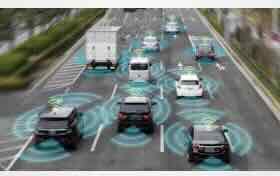
Last month, Harvard Kennedy School lecturer Mark Fagan joined Andrew Miller, an author and speaker specializing in mobility innovation, to discuss “Steering the Driverless Revolution: The Law and Regulation of Autonomous Vehicles” at an event hosted by the Harvard Law and Technology Society. Fagan pointed out that robotaxis have already begun operating in San Francisco, Los Angeles, Las Vegas, Phoenix, and Austin. However, he acknowledged that the pace of implementation has lagged behind his initial expectations, following his first symposium on the subject in 2015.
According to Fagan, the technology has vastly improved in a short time, but the biggest obstacle is now opposition from competing industries. He recounted a recent example in which a Massachusetts state legislator filed a bill on behalf of Waymo, a leading autonomous vehicle transit company, prompting backlash. “They had the hearing for the bill, and the hearing was filled to the brim with taxi drivers and rideshare drivers because this is an existential threat to them,” recalled Fagan. “They’ve now been working on the Boston City Council and, more importantly, are gathering signatures for a ballot initiative that would require all autonomous vehicles to have a safety driver at all times.”
“Ten years later, we are nowhere near the adoption I’d anticipated… but we’re at a really exciting moment because the technology seems to have become really good and really safe.”
Fagan argued that such a requirement would effectively “kill the industry” in Boston, a point echoed by Miller, who described the current landscape of driverless vehicle development as dominated by political and legal hurdles rather than technological ones. “We’re at a point where the problem is no longer technical; it’s political,” said Miller. “Or, to be more precise, it’s legal and regulatory.” He warned that “the danger of regulation is regulatory capture,” adding, “That’s what I see here: a disruptor coming along and the policies and regulations being used as a cudgel to try to swat it down.”
In closing, Fagan acknowledged that even if automated vehicles become the industry standard, significant challenges will remain. Ironically, widespread adoption would demand additional oversight. “In a world of widespread vehicle automation, congestion is going to be amazingly high,” Fagan said. “Once the financial costs and additional costs of taking a car trip decrease, it’s going to explode and put stress on the system. Every trip will take twice as long because they’re all using GPS, which will require its own regulatory response.”
https://www.linkedin.com/pulse/harvard-law-today-coming-regulatory-fight-over-autonomous-4urne/