Harvard Law Today – Linked In
Highlights from this issue:
- Experts examine the Trump administration’s efforts to reshape executive power.
- A conference at Harvard Law explores Indigenous issues across the legal landscape.
- Images from the Ames Moot Court Competition semi-final round.
For more from Harvard Law School, follow us on Facebook, Threads, YouTube, and Instagram, or visit our website.
Ideas

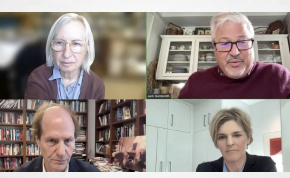
President Donald Trump’s moves to stymie, purge, and even dismantle administrative agencies represent an unprecedented assertion of presidential power over Congress and the federal government’s administrative apparatus, argued four experts at Harvard Law School on Monday.
While the U.S. Constitution charges the chief executive with carrying out the law, which includes activity at administrative agencies such as the Department of Justice, the Department of Education, and the Environmental Protection Agency, these entities were created and are funded by Congress.
Cass Sunstein ’78 argued the Trump administration’s efforts fit into three categories: actions that “might be unlawful, but it’s within the domain of ordinary discourse;” those he called “deviant,” because they depart from settled understandings; and others that are “revolutionary.” “I would not applaud the revolutionary steps we might be seeing [today].”
“It’s far easier to dismantle, downsize, and restructure than it is to build back the expertise and morale.”
One of the most striking impacts for Professor Jody Freeman LL.M. ’91 S.J.D. ’95 is the reduction or elimination of independent lawyering in the federal government. The result, she argued, is an extraordinarily empowered president unchecked by Congress that risks an “unbalancing of our traditional separation of powers.”
“It is remarkable the extent to which the Trump administration has been trying to eliminate all the friction, to eliminate independent voices [inside the executive branch],” agreed Professor Jack Goldsmith, who argued that the judiciary, not Congress, would likely have the final word. “The action is ultimately going to be in the Supreme Court.”
Indian Law Symposium

When Elizabeth Hidalgo Reese ’16 teaches tribal law at Stanford, she sometimes feels “really depressed.” Her malaise, Reese told the crowd during a daylong Indian Law Symposium at Harvard Law last week, is partly due to the history of federal Indian law and the fact that many students and others have opted not to pursue Indian law advocacy because they consider working within the current legal framework a capitulation.
Reese delivered her comments during “De-Othering Indian Law: Indigenous Topics as Canon Legal Doctrine.” The conference, organized by the school’s Native American Law Students Association, covered topics including federal Indian law and Indigenous rights, the importance of Indigenous knowledge to criminal justice, and the need to better integrate Indigenous law and history into legal education.
In her question-and-answer session, “Indian Law as Central to U.S. Constitutional Law,” Reese detailed the inherent concerns with Indian federal law, noting that they stem from the way Native American tribes are mentioned in the Constitution, and a legal framework based on that limited representation that has given the U.S. Supreme Court broad authority.
Cravath Fellows

In January, 88 Harvard Law School students traveled to 37 countries to undertake clinical placements or independent research with an international, transnational, or comparative law focus. This year, 12 of them were selected as Cravath International Fellows. Harvard Law Today looks at the experiences of three of these students.
Clinics

On a chilly day in January, a group of high school students stood outside the Franklin County Courthouse in Frankfort, KY, to explain why they had just filed a major lawsuit against their home state. They allege that the commonwealth had not fulfilled its obligation to provide them with an “adequate and equitable” education, defying their state constitution.
“Right now, half of Kentuckians can’t name a local elected official or our three branches of government,” said one young member of the grassroots Kentucky Student Voice Team (KSVT). Plaintiffs from KSVT are being represented by the Harvard Law Education Law Clinic in asking the district court to confirm that their educational rights had been violated.
When Harvard Law students learned about KSVT and its grassroots focus on local youth voices, they were eager to connect to hear more about the Kentucky students’ advocacy. “We thought we had found a group from whom we could learn a lot about the long-term impact of education adequacy litigation,” explained Michael Gregory ’04.
Peter Goeckner ’25, a student in the legal clinic, says that working with the group has been inspiring. “It’s amazing, that in this day and age, with technology making us feel further apart than ever, this group is getting back to the core of engaging people in the community and state and working together despite political differences.”
Read more
https://www.linkedin.com/pulse/harvard-law-today-president-takes-administrative-state-imnqe/