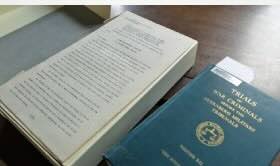
n Thursday, the Harvard Law School Library released a digital archive of its records from all 13 Nuremberg trials, a massive trove of documents chronicling the effort after World War II to bring Nazi leaders to justice. The first complete set of Nuremberg records to be made publicly available online, the archive is fully searchable. Its release comes on the 80th anniversary of the first trial, an international military tribunal convened on November 20, 1945 that prosecuted 22 of the surviving top leaders from Nazi Germany. During the subsequent four years, a total of 199 Nazi officials were tried, and 12 were given death sentences. Just three were found not guilty. Numerous Harvard alumni were involved in the proceedings, including prosecutors Telford Taylor, LL.B. ’32, and Benjamin Ferencz, LL.B. ’43, and tribunal judge Francis Biddle, LL.B. ’11.
The library’s digitization project got underway in 1998 and was initially conceived as a way to preserve the fragile documents, which fill some 730 boxes, while also making them widely available. One of several major institutions in the United States and Europe to possess copies of the trial documents, Harvard received the bulk of its archive in 1949, after the last trial ended. In the decades since, other related records have been donated and added to the archive. “For the most part, these are 1940s-era acid-based mimeograph sheets of paper,” says Paul Deschner, who led the digitization project. “And basically, all that stuff is crumbling as we speak.” The deterioration became such a problem that in the early 2000s, the library had to take the physical archive out of circulation.
The database now houses some 140,000 documents—more than 750,000 individual pages. This includes records from the trials themselves: transcripts, briefs, and evidence exhibits for both the prosecution and defense. There is also a vast pool of what Deschner calls “source documents,” which were never used at trial but were dug up by investigators at the time and selected as relevant to the effort to understand the Nazi regime. Altogether, it’s an astonishing breadth of material, “almost everything imaginable,” Deschner says: letters, memos, meeting minutes, diaries, telegrams, newspaper clippings, journal excerpts, maps, photographs, and organization charts of the Nazi hierarchy. There are records from a 1942 meeting in Berlin where the Holocaust was introduced as an official policy. A 1945 photograph shows the Nuremberg cell block where the Nazi defendants were being held, with a soldier standing guard outside each cell door.
https://www.harvardmagazine.com/university-news/harvard-law-school-nuremberg-papers