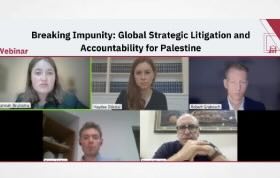
On 22 July 2025, Law for Palestine, in collaboration with Al Mezan Center for Human Rights, ESCR-NET International Network for Economic, Social and Cultural Rights, ETO Consortium, and the International Centre for Justice for Palestinians (ICJP), hosted a webinar titled “Breaking Impunity: Global Strategic Litigation and Accountability for Palestine.” The event, which is the first in a two-part series, brought together prominent legal practitioners, human rights defenders, and civil society representatives to discuss the potential of strategic litigation, universal jurisdiction, and corporate accountability in confronting Israeli impunity for international crimes committed in the occupied Palestinian territory (oPt).
The webinar, the fifth in Season 3 of the Jurists for Palestine Forum, focused on the role of states, civil society, and legal professionals in ending the ongoing genocide in Gaza and broader Israeli violations through domestic and international legal mechanisms. It particularly addressed how corporate actors and complicit third states can be held accountable under international law.
Moderated by Hannah Bruinsma, Access to Justice Coordinator at Law for Palestine, the webinar featured four prominent speakers: Issam Younis, General Director of the Al-Mezan Center for Human Rights; Haydee Dijkstra, Barrister at 33 Bedford Row Chambers and Acting Chief Counsel at ICJP; Robert Grabosh, German lawyer and expert on Business & Human Rights; and Gerry Liston, Senior Lawyer at GLAN, focusing on illicit financial flows and illegal settlements.
The discussion opened with a critique of European states’ continued reluctance to impose sanctions or reassess their relations with Israel, despite mounting evidence from Palestinian and international organisations documenting ongoing atrocities. The moderator emphasized that focusing solely on humanitarian aid -while ignoring the broader context of systemic injustice- allows the occupation to continue unchecked.
Bruinsma also highlighted the vital role of legal strategies in holding states and corporations accountable, citing recent breakthroughs such as the Flemish court’s order to halt military shipments to Israel and the Belgian Federal Police’s arrest of two Israelis. Additionally, she pointed to the significant commitment made by several Global South states at the Hague Group Emergency Conference on Palestine in Colombia. These nations have pledged to use universal jurisdiction as a tool for holding individuals criminally accountable for violations of international law. Bruinsma noted that this growing momentum marks a new phase in the struggle for justice, one that moves beyond rhetoric and towards meaningful, concrete action.