
Reported via Hong Kong Free Press..
China is the world’s largest jailer of writers, according to PEN America’s Freedom to Write Index 2022, released on Thursday. The free expression NGO counted 90 cases of writers behind bars, with six new cases added last year.
It is the fourth consecutive year that China has topped the index.
Read the full report at
Freedom to Write Index: China worst jailer of writers in 2022, NGO says
Here’s the report at PEN
Introduction
In May of 2022, at the PEN America emergency writers congress, Salman Rushdie spoke about global threats to human rights and democracy, including Vladimir Putin’s assault on Ukraine, and said:
“It has been said, I have said it myself, that the powerful may own the present but writers own the future, for it is through our work…that the present misdeeds of the powerful will be judged…We must understand that stories are at the heart of what is happening, and dishonest narratives of oppressors have proved attractive to many. So we must work to overturn the false narratives of tyrants, populists, and fools by telling better stories than they do.”
Three months later, when Rushdie was brutally attacked on a stage in Chautauqua, New York, in August 2022—more than three decades after the Ayatollah Khomeni issued a fatwa against him for his novel, The Satanic Verses—it served as a devastating reminder of the perils writers face for having the audacity to put their ideas, their creative vision, and their stories to paper. A reminder of the ways in which the powerful may attempt to silence words that can inspire people to think beyond the boundaries those in power would draw. But Rushdie has also embodied—in this work and his life—the ways in which writers’ words persist, and how writers themselves refuse to be silenced. Writing, wherever it occurs, is an act of fearlessness, of risk-taking, and of defiance. And in 2022, writers from Myanmar to Iran, from Ukraine to China, have demonstrated that courage, even in the face of brutal attempts to silence their voices.
In 2022, the state of free expression globally remained perilous. Yet the world also witnessed many courageous acts in defiance of repression, and in two countries in particular, the human will to assert demands for freedom, even in the face of shocking brutality. The people of Ukraine have demonstrated powerful, tenacious resilience since Russia’s brutal invasion began in February 2022, defending their land, but also their culture and their individual stories. And in Iran, women have led a diverse, dauntless protest movement to demand their rights, shaking the very foundations of the regime. In these and many other countries, writers have played an essential role, giving voice to public demands for freedom, democracy, and justice.
They have also paid the price. In Ukraine, poet and children’s book author Volodymyr Vakulenko was abducted from his home by Russian occupying forces in March, 2022; not until November would his body be identified as among those in a mass grave, unearthed after the liberation of Kharkiv. In Iran, women writers and poets have been detained frequently during the protests, often held for short periods of time, but sometimes repeatedly, and subject to mistreatment and torture. In January 2022, Iranian writer Baktash Abtin—jailed for his advocacy in defense of free expression—died of COVID-19 while in state custody, after the government delayed providing him the medical care he needed. In Egypt, blogger Alaa Abd El Fattah underwent a months-long hunger strike to protest being denied access to bedding, sunlight, exercise, and reading material for over two years. And in at least 36 other countries, writers have been locked up for exercising their freedom of expression.
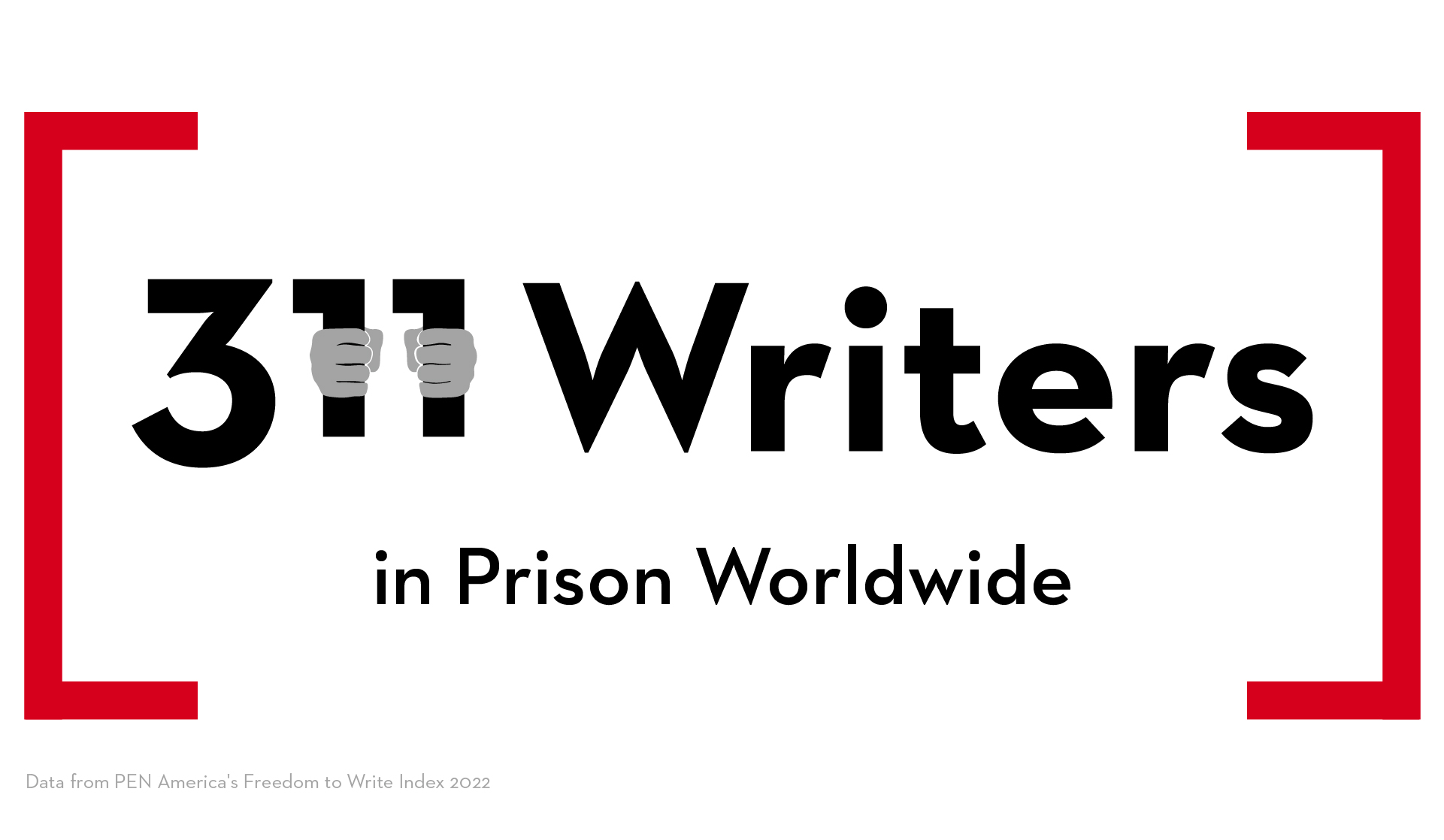
The Freedom to Write Index tracks the detention and imprisonment of writers, and in 2022, 311 writers were detained or imprisoned around the world for their writing or otherwise exercising their freedom of expression. That includes 84 new cases of writers put behind bars, many of which occurred in Iran, where writers have long been particular targets of the regime, but especially so during this past year’s “Woman, Life, Freedom” protests.
Unjust imprisonment deprives writers of their most fundamental rights, and often of the freedom to write, as well. Some writers are able to continue their work from prison, often sneaking their writing out to ensure their voice can still be heard. Elevating the words of those imprisoned for their writing is an essential act of solidarity and defiance. But prison can also severely constrain the ability of a writer to create new work.
Read the entire report at