Columbia’s Law Library has been at the heart of the intellectual life of the Law School since its founding in 1858. Over the decades, the library has been housed in numerous locations around New York City, and its wide-ranging collection has evolved alongside the Law School itself.
For the Record: A History of the Law Library Through Artifacts and Treasures, designed to coincide with the opening of the Li Lu Law Library, celebrates this history. The special exhibition features a curated selection of rare artifacts and treasures, drawn from the Arthur W. Diamond Special Collections of the Law Library and Columbia University’s Rare Book & Manuscript Library, that illuminates the shared history of Columbia Law School and the Law Library, and a community long devoted to the pursuit of knowledge, justice, and academic excellence.
Below, see more about each artifact included in the exhibition. Artifacts are divided into six sections representing the location the Law School and Law Library occupied when the artifact was created or acquired.
1859–1873: 37 Lafayette Place
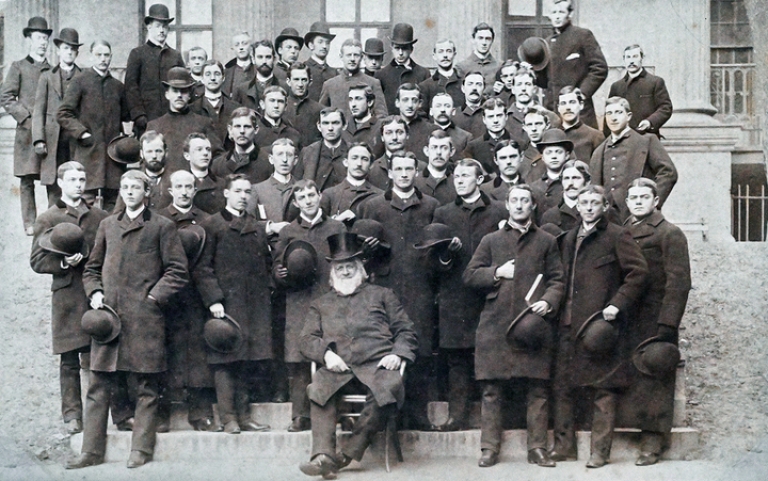
Theodore W. Dwight and His Students
photograph, undated
Theodore W. Dwight served as the first Dean of Columbia Law School, then known as the Law School of Columbia College, from 1864 to 1891. At the time, the school was located at 37 Lafayette Place in a former residence of John Jacob Astor. The Lower Manhattan location offered proximity to the courts, financial district, and law offices where most students were simultaneously working as apprentices. Students had access to the Astor Library (now the Public Theater) across the street.

An Introductory Lecture, Delivered Before the Law Class of Columbia College, New York, on Monday, November 1, 1858, by Theodore W. Dwight, Professor of Law
New York, By the Authority of the Trustees, 1859
This volume contains the first lecture delivered to law students at Columbia by Theodore W. Dwight, who was appointed Professor of Municipal Law in 1858. Dwight delivered his inaugural address at the New-York Historical Society building, located at the corner of 11th Street and Second Avenue, where the school was briefly housed until 1859. Dwight went on to become the Law School’s first dean (1864–1891). During his tenure, Dwight introduced an innovative mode of legal pedagogy known as “The Dwight Method.” In lieu of the prevailing office apprenticeship as a means of legal education, Dwight developed a formal educational approach incorporating lectures, examinations, recitations, quizzes, moot trials, and Socratic dialogue with students.
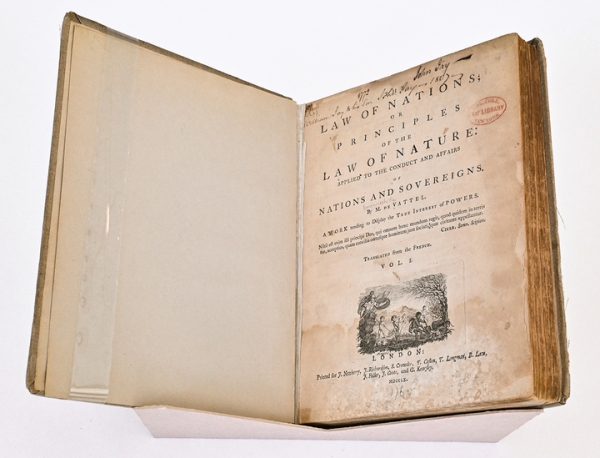
The Law of Nations, or Principles of the Law of Nature, Applied to the Conduct and Affairs of Nations and Sovereigns, by M. de Vattel. Volume 1.
London: Printed for J. Newberry [etc.], 1760
One of the first major collections acquired by the Law School library was donated by John Jay II, who graduated from Columbia College in 1836. Jay was the grandson of John Jay, the first chief justice of the United States, who graduated in 1764 from King’s College (the precursor to Columbia). The 650 volumes in the collection (including the book on view) came to the Law School from the libraries of John Jay and his relatives in 1860.
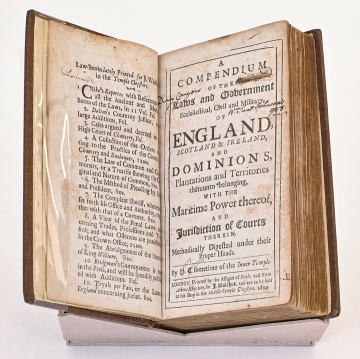
A Compendium of the Laws and Government Ecclesiastical, Civil and Military, of England, Scotland & Ireland and Dominions, Plantations and Territories thereunto belonging, with the Maritime Power thereof, and Jurisdiction of Courts therein: Methodically Digested under their
Proper Heads, by H.C. (Henry Curson)
London: Printed by the assigns of Rich. and Edw. Atkins, esquires, for J. Walthoe …, 1699
The library of William Samuel Johnson, a signer of the U.S. Constitution who served as the third president of Columbia College (1787–1800), was donated to the school in 1859. The collection contains several volumes dating to the 17th century, including the book on display.
1873–1883: 8 Great Jones Street
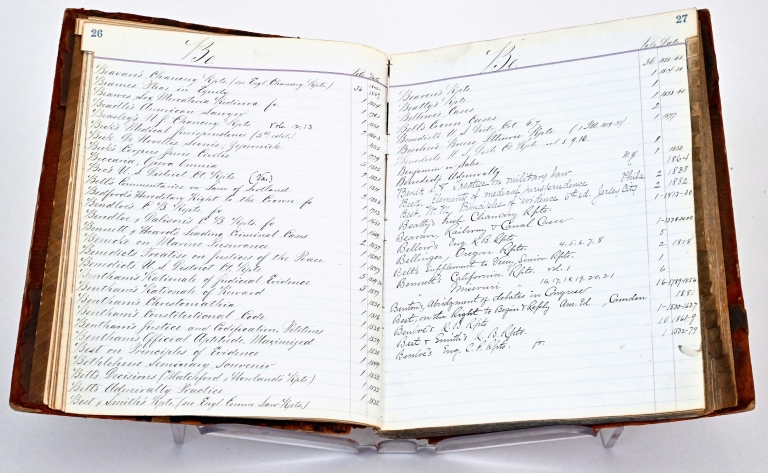
Catalog of Law Library Collection
1879
The Law School grew rapidly in its early years, and by the time it was established in its Great Jones Street location, the school was enrolling classes of more than 150 students. The two-year course of study focused on municipal law, contracts, real estate, equity jurisprudence, commercial and admiralty law, tort law, criminal law, evidence, pleading, and practice.
Learn More
https://www.law.columbia.edu/news/archive/record-history-law-library-through-artifacts-and-treasures