Published originally on Linked In
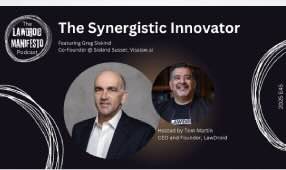
In this insightful podcast episode, Greg shares his remarkable journey from an early career pivot into immigration law to becoming one of the country’s leading voices in the field. He dives deep into how he built multiple successful ventures simultaneously, from running a thriving 30-year law practice to authoring the massive 4,000-page AILA Practice and Procedures Manual, to creating VisaLaw.ai, which won the first Artificial Intelligence Award at the American Legal Technology Awards. Greg also demonstrates how he’s leveraged his extensive writing and knowledge management work to create powerful AI tools that help lawyers serve their clients more effectively.
His stories and insights underscore his synergistic approach to building a career where each activity reinforces the others, whether it’s weekly livestreams that keep him current for both client work and AI knowledge base curation, or litigation work that showcases AI capabilities. This episode is a must-watch for anyone interested in how to build a multifaceted legal career that combines practice, innovation, and social impact.
The Skinny
Greg Siskind, founding partner at Siskind Susser and creator of VisaLaw.ai, shares his three-decade journey in immigration law, from nearly leaving the profession before accidentally discovering his calling to becoming one of the field’s most prominent voices. With a uniquely synergistic approach, Greg demonstrates how he’s built multiple successful ventures that reinforce each other: practicing immigration law, authoring eight books including AILA’s 4,000-page practice manual, and creating AI tools that democratize access to legal expertise. Throughout the conversation, Greg discusses the current intense period in immigration law with the new administration, including his work challenging a $100,000 H-1B tariff that affects everyone from tech workers to rural teachers and priests. His passion for immigration law stems from its deep connection to American history, the tangible results lawyers achieve for clients, and his fundamental belief in people’s right to live where they choose. Greg’s career exemplifies how finding substantive work you love, staying organized with technology, and looking for ways each project can benefit others creates a sustainable and impactful legal career.
Key Takeaways:
- Greg nearly left law before discovering immigration practice, which he found substantively fascinating due to its deep connection to American history
- Immigration law has transformed from a relatively obscure, happy specialty to one of the most high-stress areas of practice, with dramatic week-to-week developments
- Greg is currently working on litigation challenging a presidential proclamation imposing a $100,000 tariff per H-1B worker, which affects far more than just tech companies, including rural hospitals, K-12 schools, and religious institutions
- His approach to managing multiple ventures involves finding synergies where work in one area benefits another, such as weekly livestreams that both serve clients and help curate the AI knowledge base
- The 4,000-page AILA Practice and Procedures Manual that Greg co-authors became the foundation for VisaLaw.ai after testing it in Co-Counsel’s early platform at Pablo Arredondo’s suggestion
- Greg stays current by doing weekly livestreams with colleagues about immigration law developments, which helps him manage both client work and the AI product’s knowledge library
- His legal blogging journey started in 1994 with a simple website, eventually becoming VisaLaw.com, which attracted a wide audience including people seeking immigration help
- The immigration bar is now 70% women and is notably collegial, perhaps because the government is the common opponent rather than other lawyers
- Greg finds that when immigration law gets harder, winning cases feels even better because it requires exceptional lawyering to achieve results for clients
- He emphasizes that older kids and delegation of day-to-day work to other attorneys has allowed him to focus on the most important aspects of each venture
Notable Quotes:
- “I tell people it’s like they have a hard time believing that for the first half of my career, immigration was pretty obscure, pretty boring stuff. And I mean, yeah, it was changing from administration to administration. But honestly, most people didn’t know really. They didn’t know what immigration lawyers did.” – Greg Siskind (04:45-04:59)
- “It used to be immigration law was they would do these surveys of the happiest—we would be the happiest of any legal specialty when they surveyed us and the lowest paid. Now it’s probably lowest paid and most stressed out at the same time.” – Greg Siskind (05:15-05:27)
- “I wouldn’t be practicing law if it wasn’t—if I didn’t find immigration law. I was actually planning an exit, an early exit from law until I accidentally got assigned, well, it wasn’t accidental that I got assigned the case, but once I saw it, I liked it. I was like, oh, maybe I’ll stay with law. And now it’s 30 some odd years later since that first case.” – Greg Siskind (05:33-05:50)
- “I’m on that team challenging a proclamation that the president signed about a week and a half ago that charges a $100,000 tariff per H-1B worker, which is a lot even for your big companies out there, but it’s pretty impossible for a church that’s planning on paying someone to bring a priest over or a K-12 school that’s trying to get a math teacher in a rural school district.” – Greg Siskind (03:33-03:58)
- “I was an early tester of Co-Counsel before Co-Counsel released their product, and I was able to have my book in that product to be able to test out how it answered questions. And Pablo told me that I should look at trying to build this company. So he was a great encourager on there.” – Greg Siskind (47:42-47:56)
- “I sometimes find ways that I can sort of leverage what I’m doing in one space to help me in another way. If you could double it up, you can get more mileage for what you’re doing. Why not?” – Greg Siskind (48:05-48:13)
- “I always have thought that the whole country’s history is intertwined with developments in immigration law, whether you went back to the Alien Enemies Act or you went forward through the Chinese Exclusion Act and through the developments throughout American history. I thought that was really interesting.” – Greg Siskind (48:52-49:10)
- “I’m a firm believer in the rights of people to live where they want to live. And the United States is their choice. I would like to make it possible for them to be here. So I really love the results. Every time I win, I feel great about it.” – Greg Siskind (50:20-50:36)
- “When it gets harder and I can get those results for clients, you feel even better about it because you know that really, in a lot of cases, it required good lawyering to be able to get to that result.” – Greg Siskind (51:24-51:36)
- “I just saw, by the way, that the immigration bar is now 70% women. And that’s been sort of over the years has been progressively more and more. I think you really see the results of your work in very tangible ways.” – Greg Siskind (49:55-50:16)