
President Donald Trump appears to be trying to recreate 17th-century mercantilism for the 21st-century digital economy. Back in August, responding to European regulations that expect responsible behavior by the dominant digital companies, he wrote on Truth Social, “As the President of the United States, I will stand up to Countries that attack our incredible American Tech Companies.”
Centuries ago, European governments protected favored firms operating abroad. As this Truth Social post illustrates, the dominant American digital companies—Big Tech—have been similarly successful in cultivating President Trump to protect them from the regulatory expectations of other nations, especially Europe.
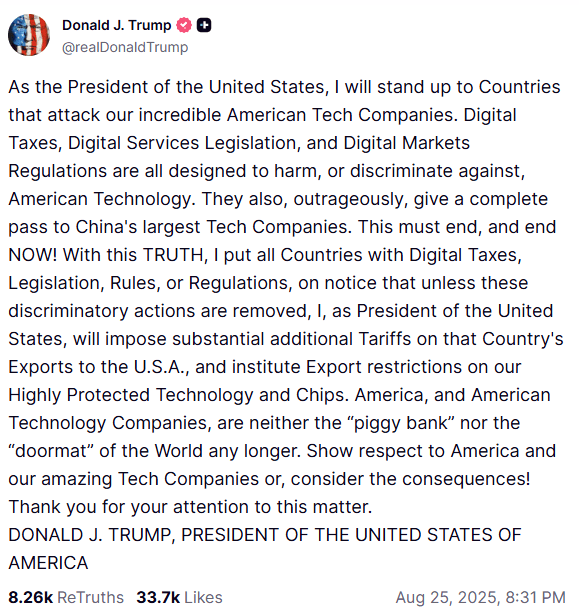
An August 25, 2025, post from President Donald Trump on Truth Social.
Digital mercantilism
From the 16th through the 18th century, European nations used tariffs, monopolies, and political power to shield favored companies. This policy, called mercantilism, created winner-take-all opportunities for the politically privileged.
Mercantilism once protected companies from competition. Trump’s digital mercantilism protects a business model.
The dominant digital platforms of the internet became monumentally profitable in part by avoiding costs associated with responsible behaviors such as protecting user privacy, accountability for the content they distribute, and avoiding anticompetitive behavior. Economists call this “externalization”—the shifting of burdens that should be the responsibility of a company to users and society.
When President Trump speaks of “Digital Services Legislation,” he is referring to the EU’s Digital Services Act (DSA) and the expectations it establishes for platform-delivered content. The expression “Digital Markets Regulation” refers to the Digital Markets Act (DMA), designed to protect competition in online markets. Apparently, he sees requiring dominant companies to be accountable to the public interest as an act “designed to harm, or discriminate against American Technology.”
What President Trump leaves out
President Trump’s post is missing any recognition of the interests of American citizens, focusing instead on the corporations whose practices have harmed those citizens.
Because of the absence of American regulatory oversight, these companies have, among other things, engaged in monopolistic behaviors, avoided responsibility to the truth in what they distribute, designed their products to be addictive, and violated the personal privacy of their users—all for the purpose of expanding profits.
The EU has attempted to rebalance the market by requiring dominant companies to accept responsibilities they have worked to avoid. On the other hand, the president of the United States seeks to protect the magnification of Big Tech’s profits through the reduction of its responsibilities.
This approach marks a sharp departure from the U.S. government’s traditional treatment of American industry. Automobile manufacturers, for instance, must bear the costs associated with producing a safe product, such as installing airbags, seatbelts, or emission controls. In contrast, Big Tech has been able to sidestep the costs of addressing its own safety problems, such as misinformation, addictive use by young people, and the adverse consequences of creating an information ecosystem solely designed to maximize advertising revenue.