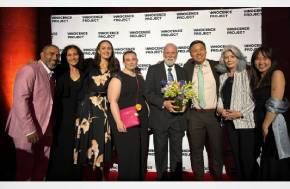
When Sean O’Brien (J.D. ’80) graduated from the University of Missouri-Kansas City School of Law, he was prepared for a career in business and tax law but soon found his calling in public defense. More than four decades later, the Innocence Project honored him with its Award for Freedom and Justice, recognizing his role in ending a St. Joseph woman’s 43-year incarceration, the longest known wrongful incarceration of a woman in U.S. history.
Throughout his career, O’Brien has defended clients on death row, helped free wrongfully convicted people through pro bono work and successfully argued two cases before the U.S. Supreme Court.
O’Brien estimates he is directly responsible for litigation that has helped 43 people in cases involving death sentences, wrongful convictions and juvenile offenders sentenced to life without parole.
His relationship with the Innocence Project dates to its founding in 1992 and has continued ever since.
“I am typically the Innocence Project’s go-to lawyer when they need local counsel in a Missouri case,” O’Brien said. “The Schlup v. Delo case that I did in 1995 sets the standard for actual innocence in habeas corpus litigation in America, so I have been called in as a consultant or co-counsel on a lot of the Innocence Project’s cases over the years.”

The Innocence Project began in 1992 at the Cardozo School of Law in New York, New York. Over time, similar groups formed across the country; some based at law schools, others operating as independent nonprofits. They work separately but stay connected through the Innocence Network, a loose coalition that provides annual training, fundraising support and other programs.
In 2003, O’Brien joined the founding board of directors for the Midwest Innocence Project, serving until 2010. He has remained active in innocence work, including his work in the exoneration of Sandra Hemme.

Hemme was 20 years old when she falsely confessed to a 1980 murder she did not commit in St. Joseph, Missouri. She was exonerated in December 2024 after serving 43 years in prison. Upon release, she was 64 years old.
“What is unusual about this case is that the New York team hired my daughter Quinn to be Sandy’s lead investigator, and when the investigation was substantially complete, they asked me to be local counsel,” O’Brien said. “I was the only lawyer in the courtroom, including the judge, who was born before Sandy went to prison. In fact, I had been a lawyer for less than three months when Sandy went to prison, so she has been there for most of my legal career.”
He remembers Hemme as a remarkable client.

“She demonstrated bravery and kindness throughout her ordeal. It was a privilege to represent her,” O’Brien said.
The Innocence Project’s recognition, he added, carries special meaning.
“This was truly a meaningful recognition, coming from lawyers I have known and admired for many years,” O’Brien said. “It’s a nice capstone for a meaningful career. I have received other awards, but this one comes from the seasoned advocates in the trenches, and I can’t begin to say how much that means to me.”
O’Brien’s impact extends into the classroom. In 2023, the UMKC School of Law alumnus was named Alumnus of the Year by the UMKC Alumni Association. The following year, he received the University of Missouri System Board of Curators’ Distinguished Teaching Professor designation, the university system’s highest academic honor, recognizing his excellence in teaching, scholarship and service.
Professor O’Brien retires from UMKC on September 1 after nearly 22 years with the UMKC School of Law.
Alongside his daughter, Quinn, and several former students, O’Brien launched the nonprofit organization, the Investigation and Advocacy Service, to continue fighting wrongful convictions.
“My mother is a teacher, and it was a lifetime of her guidance that allowed me and my father to realize we also enjoyed teaching and guiding others,” Quinn O’Brien said. “When we set up IAS, it was with the idea that we would help other attorneys and their teams advocate for wrongfully convicted people. Hollywood makes movies about our clients’ stories, so it’s not hard to understand why people are interested in this work and want to do this with us. IAS allows us to assist and train people motivated to do wrongful conviction work.”
Read more