Best Books on International Law: What to Buy First
Edmarverson A. Santos
The best books on international law are not always the biggest, oldest, or most cited. The right book is the one that solves your immediate problem: learning the subject, preparing for a course, writing better legal analysis, understanding treaty law, or building a long-term reference shelf.
This guide compares ten serious books on public international law and explains how each one actually functions as a purchase.
Best books on international law: quick comparison
Use this table first. It provides the buying role for each book, so individual reviews can focus on substance rather than repeating the same buyer advice.
|
Book |
Strongest use |
Best purchase stage |
|
International Law — Malcolm N. Shaw |
Broad, reliable textbook coverage |
First serious textbook |
|
International Law — Gleider Hernández |
Modern student-focused learning |
First or second textbook |
|
Brownlie’s Principles of Public International Law — James Crawford |
Doctrinal authority and legal precision |
Reference after the basics |
|
International Law — edited by Malcolm Evans |
Wide academic coverage by specialists |
Course text or supplement |
|
International Law — Jan Klabbers |
Conceptual clarity |
First map of the subject |
|
International Law — Anders Henriksen |
Clear, concise study support |
Beginner or revision text |
|
Cassese’s International Law — Gaeta, Viñuales and Zappalà |
Critical legal argument and global justice |
Supplement after basics |
|
Public International Law — Alina Kaczorowska-Ireland |
Case-oriented legal learning |
Course companion |
|
Aust’s Modern Treaty Law and Practice — Jeremy Hill |
Treaty law and diplomatic practice |
Specialist reference |
|
Oppenheim’s International Law: Volume 1 Peace — Jennings and Watts |
Classic advanced authority |
Research-library reference |
A sensible route is simple: choose one general textbook, add a deeper reference when your work becomes more demanding, and buy specialist books only when your study or professional needs justify them.
1. International Law — Malcolm N. Shaw

Shaw is the workhorse of this list. It gives the reader a full route through public international law without narrowing the subject too early.
The book’s main advantage is its range. It can take a reader from the foundations of the discipline into major doctrinal areas such as jurisdiction, treaties, state responsibility, immunities, human rights, use of force, environmental law, law of the sea, and dispute settlement. That matters because international law often feels fragmented when studied through short notes or isolated cases.
The writing is conventional, but that is part of its usefulness. Shaw does not try to be stylish. It tries to be dependable. The result is a textbook that can be used across different stages of study: lectures, essays, revision, and later consultation.
The limitation is weight. This is not a book to rush through from cover to cover. It works better as a serious reference-textbook: open the relevant chapter, read with a purpose, then connect that chapter to cases, treaties, and class materials.
For readers who want one substantial international law book rather than a stack of narrow introductions, Shaw remains the safest anchor.
2. International Law — Gleider Hernández

Hernández gives public international law a more contemporary feel. The book is structured enough for students, but it does not flatten the subject into neat exam definitions.
Its strongest quality is the way it keeps legal controversy visible. International law depends on sources, institutions, interpretation, state practice, consent, and enforcement, but none of these operate in a vacuum. Hernández makes the reader see the tensions behind the rules rather than treating the discipline as a settled code.
That approach is useful for essays and seminars because it helps the reader move beyond description. Instead of merely saying what the rule is, the reader starts to see why the rule is contested, how courts and states argue about it, and where legal authority becomes uncertain.
Hernández is especially valuable where a reader wants modern structure with analytical depth.
3. Brownlie’s Principles of Public International Law — James Crawford

Brownlie is not written to comfort the beginner. It is written for legal precision.
The book is strongest when the reader needs authority rather than explanation. It is the kind of text that helps with advanced essays, legal submissions, moot court preparation, and serious research. It rewards slow reading and careful use.
The risk is buying it too early. If the basic vocabulary of public international law is still unfamiliar, Brownlie may find it unnecessarily difficult. That does not make it a bad book. It means the timing matters.
Brownlie earns its place because serious international law eventually requires more than accessible summaries. It requires doctrinal control.
4. International Law — edited by Malcolm Evans

That format has a clear benefit. Public international law changes character depending on the topic. Human rights, environmental law, law of the sea, use of force, international criminal law, and dispute settlement do not all require the same emphasis. An edited textbook can reflect that variety better than a single-author book.
The trade-off is unevenness. A single-author textbook usually gives a smoother reading experience. Evans gives a broader one. Some chapters may feel more direct, others more technical, but that variation is not necessarily a defect. It reflects the fact that international law is not a single-track subject.
Evans is valuable because it shows international law as a field of multiple conversations, not a single lecture.
5. International Law — Jan Klabbers
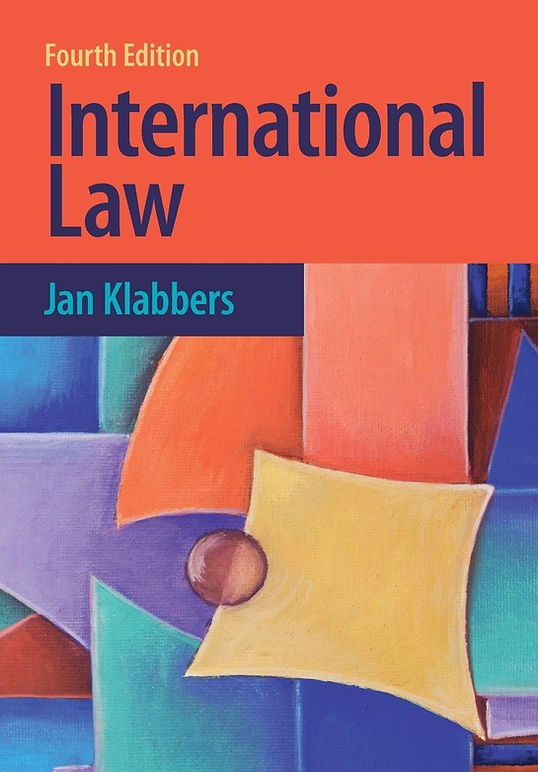
Klabbers slows the subject down. That is the book’s real value.
Many readers struggle with international law because they meet too many moving parts at once: states, treaties, custom, courts, international organisations, responsibility, enforcement, legitimacy, and politics. Klabbers helps the reader understand how those pieces connect.
The book is more conceptual than encyclopedic. It is not trying to answer every possible research question. It is trying to make the architecture of the discipline visible. That makes it useful when the reader needs orientation before moving into heavier materials.
Its style also suits readers coming from international relations, diplomacy, political science, or global affairs. It does not reduce international law to rules alone. It keeps institutions, power, and legal structure in the picture.
The limitation is built into its design. Klabbers will not replace larger textbooks or references for detailed research. But as a way to understand the logic of the field, it does its job very well.
Read more https://www.diplomacyandlaw.com/post/best-books-on-international-law