Samakhusi, October 2025: On a Saturday evening near Supreme College in Tokha Municipality, a group of young men beat a street dog to death with iron rods and stones. The act was captured on CCTV. One person was eventually arrested. The dog had no name. It had probably lived on that street for years, sleeping near the college gate, asking for nothing.
Khotang, November 2025: A 44-year-old man tied a dog to a tree in the eastern hill district of Khotang and hanged it until it died. Photographs spread online. Some community members praised the act. The case eventually reached court and the man received a sentence of one week in prison and a fine of Rs 5,000. It was the first animal abuse case to ever reach a court in Khotang. One week. For a life deliberately taken.
Satdobato 2019: A dairy farmer in Satdobato abandoned his cow on the street after she stopped producing milk. She could not walk. Her body was covered in wounds. A complaint was filed at the Satdobato Police Station against the farmer. Acting on the complaint, police held him in custody for five days then released him on bail. An organization rescued the cow, but she did not survive. “She had a lot of wounds on her body and she couldn’t move. We tried to help her but it was all in vain,” says Sneha Shrestha, founder of Sneha’s Care, the organization that had rescued the poor cow. The farmer got five days. The cow got nothing.
Kirtipur, 2024: A dog was found in Kirtipur with its eyes severely injured and bleeding after a brutal attack. Sneha Shrestha, who is also the president of FAWN, received the call and rushed to help. Rescuers went door to door through the entire village, sought police protection and spent more than ten days fighting to keep the dog alive. Then, while they were still fighting for it, the dog was taken and killed. “We did everything right,” Shrestha later said. “And it still wasn’t enough.”
These incidents should have never happened. The cruelty is visible. The numbers are not. Because Nepal still has no comprehensive system to track abandoned animals, abuse complaints, prosecutions, or shelter demand.
The scale of the problem: Estimated data
Nepal has no national database tracking stray animal populations, reported cruelty incidents, shelter capacity, or prosecution rates. The figures below are drawn from available NGO records, municipal surveys, and veterinary assessments. They should be treated as indicative rather than definitive.
A nation that loves animals on paper
There is something deeply confusing about Nepal when you look at how it treats its animals. During Tihar, dogs are draped with marigold garlands and fed sweets and other delicacies. The cow is the national animal, worshipped during festivals, called the mother of all living. Religious texts speak of kindness toward all living creatures. Buddhism, which runs deep through Nepali culture, is built on the principle of ahimsa, of doing no harm.
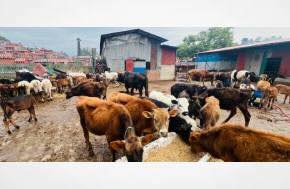
Dozens of rescued community dogs rest at the shelter of Sneha’s Care after being brought to safety, many recovering from injury and abandonment. Photo courtesy: Sneha Shrestha
And yet, stray animals across Nepal survive by feeding on garbage, drinking toxic water and suffering injuries on the road, some even harmed intentionally. Every day, somewhere in this country, an animal is being beaten to death, starved, abandoned or thrown from a running vehicle.
“Most of the time nobody reports it. When someone does, police often do not act. Some officers say they are unaware of the laws. Others say they do not know how to respond or what punishment applies,” says Shrestha. When a case somehow reaches court, the penalty is so small it barely registers.
The gap between what Nepal says it believes and what actually happens to its animals is not just wide. It is devastating.
Abandoned livestock: A structural and moral problem
Ram Bahadur Neupane, known to everyone as Gopal, has been rescuing abandoned cows and bull calves across parts of Nepal for many years. He works with small donations, personal savings and a stubbornness that refuses to let him look away.
When a dairy cow gives birth to a male calf, the farmer faces a problem. The solution, used frequently and quietly throughout Nepal, is to either abandon the calf at midnight or withhold milk for 72 hours and then allow unlimited feeding, causing the stomach to rupture and kill the animal. Gopal finds these calves with rope cuts deep in their skin, broken bones, too dehydrated to lift their heads.