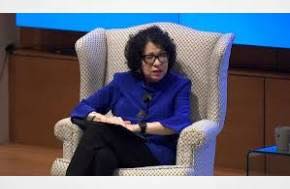
“You must learn to master the dangerous hallucination machine to do good in the world” sounds like an opening line from a Young Adults novel about the folly of rapid technological advancement. It also summarizes a Supreme Court justice’s advice to law students on becoming fluent in AI usage. Law.com has coverage:
AI systems are the “new revolution” in the legal profession, as the advent of computers were for lawyers in the latter half of the 20th century, Sotomayor said Thursday at the University of Alabama School of Law…”For every student in this room, do not graduate this institution without learning how to master AI as a tool[.]
…
“AI is a sophisticated human,” Sotomayor said. “All of its input is input from human beings. And because it is that, it has the potential to perpetuate the very best in us and the very worst in us.”That makes it particularly dangerous in “judging the complexity of human endeavors and in human situations[.]”
There is more at stake than AI’s tendency to lean in to human: all too human errors. We are the gamble. I think that Sotomayor’s best and worst in us is poetic flair that covers up a far more ominous reality: we have no idea how rapidly incorporating AI will impact us in the long run. Let’s bracket the immediate question of if AI is actually a “sophisticated human” (she’s a jurist, not a biologist after all) and instead think of it as a tool; is there any room left for Luddites in the profession? It sounds nice to recommend AI mastery — whatever that means — but what will be the subsequent consequences of 10,000 hours typing away at a delusion-encouraging black box? While they may be a little over-sensationalized, it is still worth considering the risks of AI-induced psychosis developing in communities targeted with adapt-or-die rhetoric. We also don’t know the long-term effects of regular AI use on neuroplasticity. The hard-fought talent of thinking like a lawyer could be replaced with thinking like a Harvey or Claude prompter. There’s also the the material conditions of the labor. Lawyers, especially ones in Biglaw, work very long hours and are often sleep deprived. One attorney said that in his 40 years of practice he never slept more than 3-4 hours at a time. How does using AI when exhausted change us? And what do you do when the cure all is the source of the exhaustion? And this isn’t to say that AI is bad and anyone advocating for its adoption is a snake oil salesman trying to make their money before the bubble bursts. But it is also naive to suggest that some of that isn’t happening or that our infrastructure might not be prepared to deal with it.