August 12, 2026
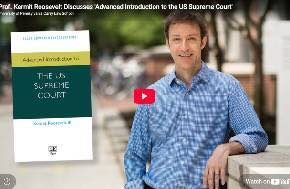
Kermit Roosevelt, David Berger Professor for the Administration of Justice, has released a new book, Advanced Introduction to the US Supreme Court (Edward Elgar Publishing, 2026).
“It’s really a book for everyone,” said Roosevelt. “And what I hope people will gain from it is a more realistic understanding of the way the Court works.”
The book unites history and theory to present a comprehensive introduction to the U.S. Supreme Court, exploring how its shifting institutional roles create conditions that often lead to two distinct visions of the Court: one where justices are heroic enforcers of the Constitution, and the other where they are villains imposing personal values on the American people.
As a constitutional law professor, Roosevelt says he had been thinking about the Supreme Court for decades. But as ideas about possible reforms to the Court grew in prevalence, he began taking a more institutional approach in assessing what the Supreme Court is designed to do, what it actually does, and how its role has evolved over history.
“I thought that it would be good to try to put together all of the insights that I developed through those different processes and write something that would explain the Court to demystify it and help citizens think about it in a productive way,” he said. “It’s become this immensely powerful institutional actor in our system of government. That’s one of the things that makes it so essential to understand why it acts the way it does.”
The book weaves historical context and the evolution of the Court’s jurisdiction with theoretical assessments about the conditions that lead to swinging public perceptions of the Court as either “good” or “bad.” From there, Roosevelt concludes with potential reform proposals—centered around the idea of term limits—for the Court to better represent the will of a durable national majority.
“[Roosevelt] deftly walks readers through more than two centuries of judicial actions, illustrating how the Court’s political nature, baked into its creation, has been cemented by decisions from the Founding era through to today,” said Gabe Roth, Executive Director at Fix the Court.
At Penn Carey Law, Roosevelt’s work is primarily focused on constitutional law and conflict of laws. A graduate of Harvard University and Yale Law School, he clerked for Judge Stephen F. Williams on the Court of Appeals for the District of Columbia Circuit and Justice David H. Souter on the United States Supreme Court. Before joining Penn Carey Law’s faculty, he practiced appellate litigation with the Chicago office of Mayer, Brown, Rowe & Maw.
Advanced Introduction to the US Supreme Court is Roosevelt’s fourth nonfiction book, following The Nation That Never Was: Reconstructing America’s Story (University of Chicago Press, 2022), Conflict of Laws?(Foundation Press, 2010), and The?Myth of Judicial Activism: Making Sense of Supreme Court Decisions?(Yale, 2006).
He is also the author of two novels,?Allegiance?(Regan Arts, 2015) and?In the Shadow of the Law?(Farrar, Straus & Giroux, 2005), and has published articles in the Virginia Law Review,?Michigan Law Review, and?Columbia Law Review, among others.
“I hope that readers will see the Court neither as this sort of nefarious group of politicians in robes, nor as this set of nine platonic guardians, but as a powerful institutional player in our system of government, the head of one of our three coordinate branches of the federal government, and an institution like any other whose design we should be thinking about,” said Roosevelt.
Learn more about Advanced Introduction to the US Supreme Court.