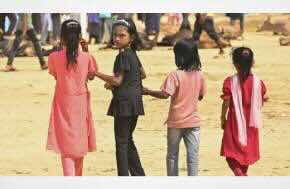
Nearly nine years after the Myanmar military launched its 2017 “clearance operations” against the Rohingya, international accountability is gaining momentum. The International Court of Justice is hearing the genocide case(Opens in new window), the International Criminal Court has sought an arrest warrant(Opens in new window) for Senior General Min Aung Hlaing, while universal jurisdiction cases are advancing in Argentina(Opens in new window), and the Independent Investigative Mechanism(Opens in new window) for Myanmar continues to strengthen evidence base for future prosecutions.
Yet for more than 600,000 Rohingya children(Opens in new window) growing up in Bangladesh’s refugee camps(Opens in new window) – and many thousands more trapped in Rakhine State – justice remains largely abstract. They continue to live without citizenship, quality education, security or meaningful prospects.
Their experiences expose a deeper flaw: international justice is more adept at documenting past crimes but far less capable of repairing the generations those crimes were intended to destroy.
The disconnect is striking because international law has already evolved. The UN Convention on the Rights of the Child recognises children as rights-holders with the right to express their views in all matters affecting them and requires those views to be given due weight according to their age and maturity. International justice, however, has yet to fully embrace that shift. It still treats children primarily as objects of protection rather than participants in accountability or justice. In doing so, it overlooks not only children’s agency but also some of the most compelling evidence of how atrocity crimes unfold over time.
Long before the military’s 2017 campaign, Rohingya children were denied nationality, birth registration, education, healthcare and freedom of movement. Many later endured killings, sexual violence, forced displacement and profound psychological trauma. These were not isolated violations but components of a systematic effort to destroy the Rohingya community’s future.
A child who witnessed massacres in 2017 may now be entering adulthood having never completed formal schooling, obtained legal identity or received sustained psychological support.
Furthermore, international justice still focuses primarily on spectacular acts of violence – mass killing, rape, village burnings and forced deportation – while paying less attention to the slower bureaucratic process through which a people are erased. For Rohingya children, genocide did not begin in August 2017. It began at birth.
The 1982 Citizenship Law rendered generations of Rohingya children stateless. Subsequent policies denied them birth registration, legal identity, education, healthcare and freedom of movement, turning childhood itself into a condition of exclusion. These measures were not merely precursors to genocide; they formed part of the machinery through which the destruction of the Rohingya was pursued.
Seen through children’s experiences, Myanmar exposes another limitation of international justice. Accountability remains overwhelmingly event-centred rather than generation-centred.
Courts investigate crimes committed during identifiable periods. Investigators collect evidence linked to particular attacks. Reparations usually follow judgments years – or decades – later.
Children experience atrocity differently.
A child who witnessed massacres in 2017 may now be entering adulthood having never completed formal schooling, obtained legal identity or received sustained psychological support. Lost childhood cannot simply be restored through a future financial award. Justice delayed for children means that justice is overtaken by development itself.
Read full article and access report