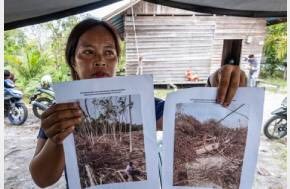
Activists Targeted for Protesting Land Grabs, Deforestation, Pollution
- Indonesian authorities are wrongfully prosecuting environmental defenders who protest deforestation and pollution as well as Indigenous leaders who defend their land rights.
- The Prabowo administration has intensified the crackdown on free expression by expanding the military’s role in state-owned mining, oil palm plantations, infrastructure projects, and so-called food and energy estates.
- The government should fairly arbitrate disputes over land and environmental damage instead of punishing those who protest abuses.
Indonesian authorities are pursuing wrongful prosecutions of environmentalists and Indigenous community leaders who protest deforestation and pollution, or defend land rights, Human Rights Watch said in a report released today. Since taking office in 2024, the administration of President Prabowo Subianto has intensified the crackdown on free expression by expanding the military’s role in state-owned mining, oil palm plantations, infrastructure projects, and so-called food and energy estates.
The 70-page report, “Grabbed Land, Silenced Justice: The Persecution of Environmentalists and Indigenous Leaders in Indonesia,” documents how Indonesian police have responded to complaints filed by company officials or politicians by silencing Indigenous villagers who demand their customary land rights and the activists who defend them. The authorities have targeted environmental and Indigenous community defenders using the criminal code and other laws to bring charges ranging from defamation to “spreading communism” to silence protest over environmental harm.
“Successive Indonesian governments have sought to silence activists and Indigenous leaders protesting forced displacement, loss of customary land, and deforestation by prosecuting them for baseless crimes,” said Elaine Pearson, Asia director at Human Rights Watch. “The Prabowo government, while cracking down on corporate corruption, has ignored local community grievances and instead deployed the military and other heavy-handed measures to pursue its economic objectives.”
Human Rights Watch examined more than 50 cases from 2015 to 2025 from the islands of Java, Sumatra, Kalimantan, Sulawesi, and the Moluccas, as well as the 6 provinces of Papua to select 15 high-profile cases as examples of specific laws and legal provisions used to target activists and community leaders, including in SLAPP (Strategic Lawsuit Against Public Participation) actions. The report is based on 69 interviews with villagers, Indigenous leaders, and environmental activists, as well as lawyers, academics, and government officials, and a review of police and court documents.
The police and prosecutors have accused critics on slender evidence of Criminal Code offenses, Human Rights Watch found. In other cases, the authorities used provisions of the Plantation Law, the Mineral and Mining Law, the Job Creation Law, or the Prevention of Forest Destruction Law. While higher courts eventually rejected most cases, the targeted activists had to spend months rebutting baseless lawsuits.
Haris Azhar, a human rights lawyer who was eventually acquitted of criminal defamation, said: “I had to spend time and energy overcoming attacks from the oligarchs and the police. I lost opportunities to build my advocacy work and to develop my professional career.”
Indonesia is the world’s biggest producer of palm oil; a major gold, timber, paper and pulp producer; and the largest supplier of nickel, a key material for making steel and electric batteries. The Prabowo government has deployed the military to build “food and energy estates,” displacing local communities in South Papua.
Indonesia: Environmentalists, Indigenous Leaders Unjustly Prosecuted