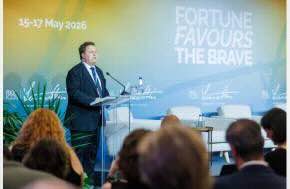
Lennart Meri Lecture 2026
As a young man, I had some meaningful encounters with President Lennart Meri. In Estonia, we have a tradition of inviting graduates who earn distinction to a festive gathering in the rose garden of the Presidential Palace in Kadriorg. I attended one in 1998, after graduating from law school and already knowing I had the opportunity to go to the US to pursue my master’s degree. President Meri shook my hand and asked whether I would continue my studies and in what field. I said I would study international law, to which Meri responded: “Oh sa nugis, seda läheb meil veel vaja!” (Oh boy, we’ll need it for sure in the future!)
The ‘we’ in that context, of course, referred to Estonia. Today, this “we will need it” can be extended to the world as a whole, because it has unfortunately become uncertain to what extent international law still serves as a barrier to aggressive wars.
A Nuclear Weapon of Small States?
My second encounter with President Meri was when he came to Berlin for a state visit in 2000, while I was a PhD student at Humboldt University. I could observe how well President Meri got along with Boris Meissner, a Baltic German legal scholar, who had written in his 1956 dissertation that, as the Baltic states had been illegally occupied and annexed by the Soviet Union, they had not lost their state continuity under international law. Lennart Meri was a writer—remember his book Silverwhite. He had a charismatic way of conveying international legal ideas in a beautiful, succinct language. For example, he wrote that during the Soviet annexation, the Baltic states found their last refuge in international law. He also called the state continuity thesis a “foundational state philosophy” for Estonia during its post-1991 independence period.
During the Soviet annexation, the Baltic states found their last refuge in international law.
On a state visit to Slovakia, President Meri was asked by a journalist what he thought about the successful nuclear tests of India and Pakistan. The president quipped that the nuclear weapon of small states is international law. In Estonia, we sometimes debate the meaning and seriousness of this metaphor. President Meri did not develop it further, so it may not be correct to treat this sentence as a manifesto or article of deep faith. There was a specific context to his statement. This is certainly true for small states when we replace ‘is’ with ‘should be’; we want and need international law to play such an important role.
In today’s lecture, I will develop a theme from a well-known episode in the life of Lennart Meri. In February 1994, he gave a speech at Hamburg City Hall, during the traditional Matthiae-Mahlzeit reception, warning the west about the rise of neo-imperialism in Russia. He particularly pointed out that in the post-Soviet space, Moscow continued to use the tone of a former imperial master. President Meri said: “[Those] who want today to really help the Russian state and the Russian people should consistently convince the Russian leadership that the time of imperialist expansions is over.” The Hamburg speech entered the annals of diplomatic history primarily because the deputy mayor of St Petersburg, who was present in the audience, could not stomach President Meri’s message and stormed out of the hall during that speech. His name was Vladimir Putin.
The Imperial Continuity
A lot was done to accommodate Russia in Europe in the 1990s and 2000s—there was the hope of Wandel durch Handel, and the country was accepted as a member of the Council of Europe (CoE) in 1996. That was also a ‘gesture of goodwill’ because both the Russian and CoE legal experts concluded that, objectively, Russia at that time did not fulfil the membership criteria. To an extent, the question of imperial attitudes that President Meri raised in his Hamburg speech was consciously pushed aside in European interactions with Russia.
Read the full lecture at
https://icds.ee/en/russias-imperial-worldview-and-international-law/