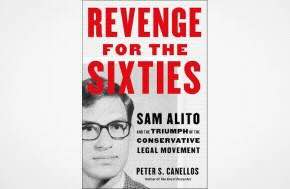
Peter S. Canellos is a prize-winning journalist and the author of Revenge for the Sixties: Sam Alito and the Triumph of the Conservative Legal Movement, which Publishers Weekly called “a razor-sharp” dissection of one of the most controversial justices on the Supreme Court, whose decisions are reshaping the United States.
Mr. Canellos is also the author of The Great Dissenter: The Story of John Marshall Harlan, America’s Judicial Hero. Four years ago, I interviewed him for SCOTUSblog about that book.
Additionally, he is the editor of the bestselling Last Lion: The Fall and Rise of Ted Kennedy. Mr. Canellos has been POLITICO’s executive editor, having led the newsroom during the 2016 presidential campaign, and the editorial page editor of The Boston Globe. Mr. Canellos has also been a Pulitzer Prize finalist and a recipient of the American Society of Newspaper Editors award in 2011 for excellence in editorial writing, along with the 2022 George Polk Award, Robin Toner Award, and News Leaders Association Batten Medal for his writing about the Supreme Court.
***
RONALD COLLINS: Welcome back to SCOTUSblog, Peter.
Most judicial biographies are turgid, hagiographic, or adversarial. I found your book engaging, with scholarly insights and impressive sourcing to boot. It offers a fascinating and revealing look into the mind of a man and the origins of a movement. Your treatment of Justice Alito struck me as balanced, replete with both praise and criticism. In some surprising ways, Alito could be proud of several of your portrayals of him, though I suspect that’s unlikely, given other accounts in your book.
In a way, and as I see it, your portrayal of Alito is psychological. For example, in a sense, Alito was always wed to Chambersburg in Trenton, New Jersey, the neighborhood of his youth. That world and its values defined him in so many ways. And you stress that the Alito story is “a parable of family, faith, and achievement.” Put it all together for us, the psychology of the man named Sam Alito.
PETER CANELLOS: Justice Alito came from a proud family of Italian American immigrants who carved out a better life while contending with hardships and prejudices. Alito embraces the idea that his parents’ and grandparents’ sacrifices enabled him to live up to his full potential. This trajectory is familiar to many families who came in the great wave of European immigration in the early 20th century, but Alito feels it with special intensity. He grew up believing in America as the land of opportunity, and that prejudice – while deeply unfair – can be overcome with fortitude and discipline. He was a dedicated Catholic churchgoer throughout his suburban upbringing in the 1950s and 1960s. He came of age at the height of the Cold War, when the liberties proclaimed in the Declaration of Independence and outlined in the Constitution were celebrated as antidotes to Nazism and Communism. I think all these factors – an immigrant family’s sense of opportunity, a churchgoer’s religious certitude, and a Cold War allegiance to original conceptions of constitutional liberties – coalesced in his mind into a single vision of an American tradition worth fighting for. Other pioneers of the conservative legal movement were driven by the same factors – immigrant family lore, religion, and the monolithic faith in the founding fathers that grew out of the mid-20th century.
You depict Alito as a child of the 1960s, but an embittered one, especially during his college and law school years. Those years were a shock to his system. As you tell it, his once-mild-mannered mindset shifted. Tell us about that evolution, starting with his years at Princeton and then moving on to his time at Yale Law School when Charles Reich, Robert Bork, and John Hart Ely were all there at the same time.
When Alito arrived at Princeton in 1968, he had every reason to believe his future was secure. He had been a star at Steinert High School in Mercerville, [New Jersey], and then part of a meritocratic wave of public-school kids refreshing the Ivy League. But it was a time of deeply unsettling change. His was the last all-male class to enter Princeton. When women arrived in his sophomore year, dorm-room conversations sometimes veered toward cohabitation, pre-marital sex, and abortion – challenging topics for a conservative teenager. It was also the height of anti-war protests. Alito was part of a relatively small number of students in ROTC, making him in some of his classmates’ eyes an emblem of the university’s connection to the Vietnam War machine. After Nixon invaded Cambodia, protesters bombed Princeton’s ROTC headquarters, and his military training was driven off campus. Faculty joined with striking students to support the postponement of exams, which Alito felt was punishing disciplined students like himself.
Read The Full interview