Imagine a courtroom in which the only voice heard is that of the state, and a legal system in which laws are skewed to conform to the whims of the regime — a world without lawyers, where the persecuted are invisible and suffer in silence. Lawyers are the necessary intermediary between citizens and their governments. They insist on normative procedures, demand evidence and testimony, challenge unlawful decisions and laws, and, when necessary, speak uncomfortable truths. That is why every dictatorship, from China to Tanzania, tries to tame them — or to break them. Russia is trying to do both.
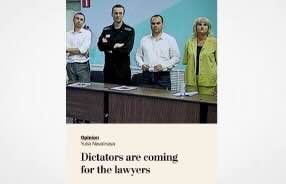
More than two years ago, Russian President Vladimir Putin arrested Vadim Kobzev, Alexei Liptser and Igor Sergunin, lawyers who worked on behalf of my late husband, opposition leader Alexei Navalny. They were bravely fighting the trumped-up accusations the Kremlin threw against Alexei, challenging his charges, the sentence, the deplorable conditions of his confinement and the inhumane “disciplinary punishments” to which he was subjected.
They were taken in on Oct. 13, 2023 — two at their homes in Moscow, the other near a courthouse in the Vladimir region, on his way to yet another hearing for Alexei. They were accused of “participation in an extremist community,” though their only crime was doing their job.
The following Monday, Alexei learned of his lawyers’ arrest from journalists. Less than two months later, Alexei disappeared within the Russian prison system. For almost three weeks, no one knew where he was: no letters, no hearings, no explanations. Only later did we learn that he had been secretly transferred to a remote penal colony near the Arctic Circle. He was tortured, starved, denied winter boots, deprived of sleep and placed in a tiny cell with a sick inmate. In February 2024, he died, murdered by Putin.
On Jan. 17, 2025, we learned that Kobzev, Liptser and Sergunin would spend, on average, four years in prison. Nothing about the case against them was lawful. The prosecution upended attorney-client privilege, arguing that privileged communication between the lawyers and Alexei was itself a criminal act. The state was rolling out a new theory of control: that the defense of a dissident is, in itself, criminal dissidence.
Today, Kobzev, Liptser and Sergunin remain incarcerated in Russia; Kobzev and Sergunin are serving their sentences in separate remote penal colonies, while Liptser is currently being transferred. Their persecution illustrates just how cancerous Russia’s system has become. By detaining Alexei’s lawyers, the regime ensured that nothing stood between it and the vengeance it sought against my husband. What followed was the logical outcome of a system designed to leave its targets defenseless. With the Kremlin criminalizing legal defense, every citizen is at the mercy of an investigator, a prosecutor and a judge acting together under instructions from the regime.
Putin’s repression of lawyers will not stop here. It will spread to more cases: against activists, political opponents and ordinary people who post the wrong thing online. The state will no longer bother to defeat arguments in court; it will just eliminate the people capable of making them.
Russia is not a standout. In authoritarian regimes around the world, lawyers are increasingly subject to attacks. In Turkey, Mehmet Pehlivan is in prison for defending the mayor of Istanbul, Ekrem Imamoglu. In Eswatini, human rights lawyer Thulani Maseko was killed outside of his home in 2023.
My husband was a politician, but he was also a lawyer by trade and deeply admired the work his colleagues did. Kobzev, Liptser and Sergunin’s persecution is an assault on Russia’s legal community and the rule of law. But it is also part of a bigger assault on a set of principles — an assault that is being replicated around the world. The global legal community must stand in solidarity with colleagues unjustly detained for doing their jobs. Civil society must bring maximum exposure to all lawyers arbitrarily imprisoned for defending justice. And governments must act and use their power of diplomacy to create and maintain an international framework that protects lawyers from abuse at the hands of tyrants.
In authoritarian societies, lawyers document repression and slow down its momentum, offering moral oxygen to those resisting the regime. Their work matters not only in defending the rights of dissidents, but also in ensuring a democratic future. And we must defend them.