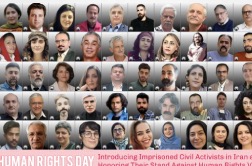
In a new report, in honor of Human Rights Day on December 10th, HRANA publishes a list of over 61 imprisoned human rights defenders and civil activists in Iran, including 8 currently being held in pretrial detention. This list is the result of ongoing collection, verification, and documentation efforts, aiming to provide a clear representation of the various dimensions of human rights violations against these defenders. The publication of this list is not merely the release of names; it tells a part of the story of Iranian civil society, in which the struggle to defend human rights can come at the cost of one’s freedom, health, and personal security.
Human Rights Day is also an opportunity to reexamine the values that form the foundation of human dignity, values such as justice, freedom, and equality, rooted in international documents and human experience. The names recorded in today’s report reflect only a portion of a broader reality, one in which human rights defenders and civil activists in Iran, solely for their commitment to human principles and peaceful activities, face deprivation of liberty, security pressures, and fundamental rights violations.
These individuals, despite the limitations and high costs, embody values recognized by the international community. Silence or indifference toward their condition is not only a disregard for human suffering but also a dismissal of the principles on which the international system is built. In this context, on Human Rights Day, HRA calls on Iran to:
- Immediately and unconditionally release all individuals detained for the peaceful exercise of their rights, and review all related convictions to vacate unjust charges and ensure reparations for victims.
- End unlawful restrictions on the freedom of expression, association, assembly, and civic engagement, and halt the use of vague national security charges that criminalize peaceful dissent.
- Guarantee due process and fair trial rights, including access to independent legal counsel from the moment of arrest, transparent legal proceedings, and full access to families, medical care, and communication.
- Prohibit torture and all forms of ill-treatment, end the use of coerced forced confessions, and allow independent monitoring and inspections of all detention facilities.
- Allow independent monitoring and international engagement, including granting access to the UN Fact-Finding Mission, Special Rapporteurs (Thematic and Geographic Mandates), and credible civil society organizations to assess conditions and investigate violations.
- Establish effective accountability and oversight mechanisms to prevent recurrence of abuses, ensure judicial independence, reform vague criminal provisions enabling arbitrary detention, and hold perpetrators who enable the cycle of abuse against activists, responsible.
|
|
|
|
|
|
|
|
|
|
|
|
|