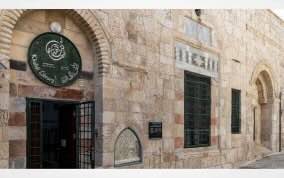
While the golden Dome of the Rock sweltered under one-hundred-degree heat a gang of heavily armed orthodox Israelis marched on a Palestinian library. Brandishing forged documents falsely claiming their ownership of the building, they enlisted the help of Israeli police in smashing the locks and entering by force. The ultra-orthodox group, with their leader Eretz Zakay, had a long history of illegally seizing Palestinian property across Jerusalem.
News of the break-in, which happened June 27, 2024, made its way to the Khalidi family, the chief caretakers of the library stretching back to the Ottoman period. For Palestinians in Jerusalem, property seizures are all too common. Oftentimes the justice system provides legal cover for this theft rather than any kind of meaningful reparation. Bracing herself for what was to come, the family’s legal representative Sana Doueik gathered paperwork and rushed to the scene.
While Sana argued with the police in the street, the ultra-orthodox settlers rampaged through the library. Word of the break-in spread like wildfire through the neighborhood, and soon a crowd of enraged Palestinians congregated in support of the Khalidis. Israeli police officers watched as the increasingly irate crowd edged closer, threatening to break the illusion of control they had so carefully established. They proceeded to beat back the Palestinian protesters, landing blows on their heads.
As night fell over Jerusalem, the settlers still had not vacated the library. While illegal, their occupation nonetheless animated plenty of supporters. An ultra-orthodox school sat adjacent to the library, and its staff supplied the settlers with sleeping mats and air conditioning for the long night.
 Library roof with Dome of the Rock. Photo by Issa Freij, khalidilibrary.org.
If the police officers had listened to Sana Doueik that afternoon, they would have learned something important: the Khalidi Library constituted a waqf, which in Islamic law is an unbreakable endowment passed down through the generations. The Khalidi family are legendary in Jerusalem. Calling the city home since the Crusades, they have built a dynasty that includes preeminent historians, economists, and even United Nations diplomats. Today, three Khalidis sit on the board of library administrators: Raja, Asem, and Khalil.
The Khalidi Library represents everything the settlers cannot abide. It is a monument to, and repository of, the history and heritage of a culture they claim should not exist.
I got the chance to speak with Raja Khalidi, who, when not running the library, is also the Director General of the Palestine Economic Policy Research Institute. He hopped on a video call from his office, recounting these events between drags of his cigarette. According to Raja, his family started the library during the Ottoman period, when they made their personal book collections available to the public. This was the first Arab public library in Jerusalem established by private initiative.
“At first it was established for scholars and judges and clerks in Jerusalem,” Raja explains, “because it is literally on the road leading up to the Dome of the Rock where these officials would go to pray five times a day.” Dignitaries would climb up Bab al Silsilah, a narrow limestone street that ducks under an arched gate. Further down, the street opens onto the broad plaza before the Haram al-Sharif, or the Temple Mount—the city’s beating heart.
In the thirteenth century, the site became a cemetery for warriors who fought in the Crusades. Over time, the library buildings expanded to encompass the cemetery, with the Crusade-era gravestones embedded in the flagstones.
Read more
https://lithub.com/the-race-to-save-a-medieval-palestinian-library/