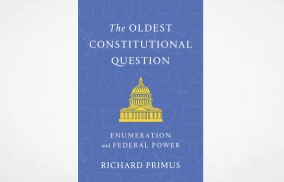
In his new book, Michigan Law’s Richard Primus argues against the long-standing orthodoxy that Congress can do only what the Constitution expressly authorizes it to do—and nothing more.
Over the years, Primus, the Theodore J. St. Antoine Collegiate Professor of Law, has taught his students that the 10th Amendment to the Constitution limits the powers of the federal government to those enumerated in Article 1, Section 8, or elsewhere in the Constitution. But he gradually came to question that interpretation.
Here, he discusses the arguments that he lays out in his new book, The Oldest Constitutional Question: Enumeration and Federal Power (Harvard University Press, 2025).
1. The title of your book is The Oldest Constitutional Question. So what is the oldest constitutional question?
This is the issue of federalism. The basic impetus for the writing of the Constitution was the need for a more powerful national government than had previously existed. But how much more powerful and how would it work? We’ve been fighting about the answer to that question ever since.
Central to the way that constitutional lawyers think about this question is the idea that the federal government is a government of enumerated powers. That means that the Constitution affirmatively lists the things that the federal government is authorized to do and the federal government can do those things and no others. This is the opposite default rule from the one for state governments, which can do anything that isn’t affirmatively prohibited.
It is a core proposition of American constitutional law that Congress can legislate only on the basis of its enumerated powers and that that limits Congress in important ways. Also, that federalism—in the way that it’s supposed to work in our system—depends on that limitation.
My book is an explanation of why I think that all of that is wrong.
2. How did you come to question this long-standing orthodoxy?
I started to think it was wrong as I taught the material year after year in the introductory constitutional law course here at Michigan. I would spend several weeks each year teaching about federalism and enumerated powers more or less in the way that I had learned them.
I would explain the significance of the fact that the Constitution enumerates Congressional powers, mostly in Article 1, Section 8, and that the reason there’s a list is to make the point that only what’s on the list is provided. If Congress were supposed to have legislative power in general, you wouldn’t need a long, detailed list.
And I would explain that the 10th Amendment, which is understood to state the rule, says the powers not delegated to the United States by the Constitution are reserved to the states.
But as I taught the material each year, I came to realize that there were a lot of things that didn’t make sense in what I was saying. For example, everyone learns that Congress is limited by its enumerated powers. But you also learn by the end of your first semester in Constitutional Law that, in practice, the enumerated powers haven’t done much work to limit what Congress can actually do in a very long time.
I learned about enumerated powers as a law student, and I believed the conventional view to be correct when I started my career as a law teacher. It took me some number of years of immersion in the material to begin changing my mind.
More
https://michigan.law.umich.edu/news/5qs-richard-primuss-new-book-asks-oldest-constitutional-question