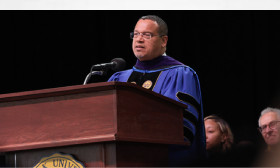
‘Being a good lawyer means standing up for democracy.’
In his Commencement address to the Suffolk University Law School, Minnesota Attorney General Keith Ellison told the graduates that being a good lawyer in 2025 means standing up for the rule of law, even when it’s hard.
Quoting philosopher John Locke’s famous observation—“Wherever law ends, tyranny begins”—Ellison argued that while our laws may be imperfect, “once the law ends, there is a new law that takes over—and that law is the law of the jungle… This is not anything remotely close to a democracy, nor is it a system of justice. It is simply might makes right.”
Ellison—who led the successful prosecution of the Minneapolis police officer who murdered George Floyd—was awarded an honorary Doctor of Laws degree at the Suffolk University Law School ceremony, one of three Suffolk commencements held at Boston’s Leader Bank Pavilion on Sunday, May 18.
“Being a good lawyer means standing up against tyranny. Being a good lawyer means standing up for democracy, and it means standing up to bullies who try to divide and exclude people,” he said.
‘There’s nothing partisan about the rule of law’
Ellison devoted much of his remarks to the role of lawyers in a time when, he said, both legal precedents and the rule of law are under attack. The president “is in the middle of bullying law firms into turning over their pro bono hours to him and revoking their security clearances because they took on clients that he perceives as enemies to himself,” he said. “I want to be clear, I’m not making a partisan statement. There’s nothing partisan about the rule of law.”
“The brave will stand up for it. And yet there are others who won’t. I want you to be among those who do.”
The questions aren’t new
While the times may feel unprecedented, the questions they raise about standing up to power aren’t new, Ellison argued. “I guarantee you that people like [Justice] Thurgood Marshall and Charles Hamilton Houston faced these same questions, and I think you know how they answered,” he said, pointing to the legal legends instrumental in building the winning strategy in Brown v. Board of Education.
He drew a direct line from these civil rights icons to today’s graduates, challenging the Class of 2025 to measure themselves not solely by traditional metrics—grades, clerkships, and the partnership track—but by questions of moral courage: “Did I stand up for the rule of law, for the Constitution, for the principles of this country?” he asked.
He told the graduates that “when DEI becomes a slur and a stand-in for words that are too ugly to say in polite company, we’ve got to fight for real DEI. There’s a lot of ways to be excluded,” he said, such as being from a remote area, being a veteran, having a disability, being a single parent. “What we’re really saying when we say DEI is: ‘We’re trying to create a system of belonging so that there is no out-crowd.’”
“When a society starts going in a dictatorial direction, lawyers have a special role to play,” Ellison concluded. “I just want you to ask yourself whether you’re willing to play it.”